Week 4 · FinalW
 vs. Kansas State
31–26+5 margin
Pregame 25–31
Game detailsSaturday Index
Loading team intelligenceBringing the latest verified football information into focus.
Big 12 · 2026 · Week 8

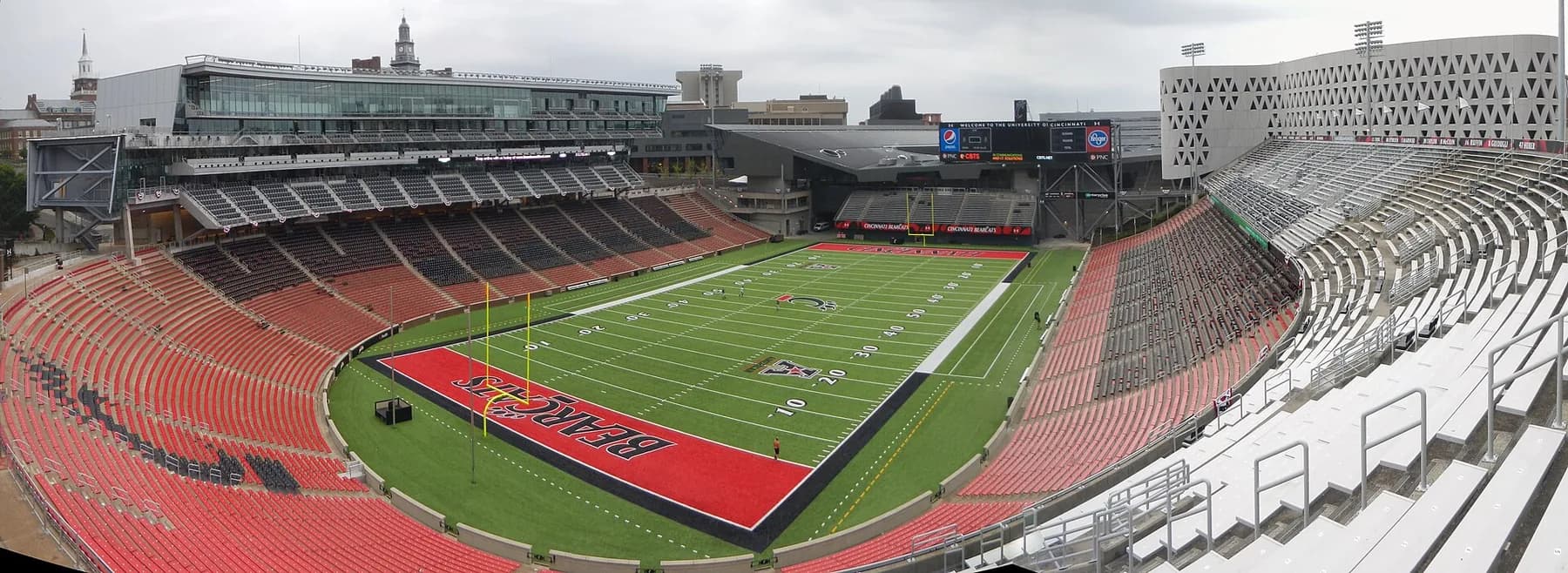
Photo: Ben Levin · CC BY-SA 4.0 · Cropped for display
Up next · Week 9
Home
Hosting
Saturday, October 31 · Time TBA
The season, taking shape
Final scores show Cincinnati first. Oldest to newest.
vs. Kansas StatePregame 25–31
Game details at Arizona
Pregame 22–33
Game details at West Virginia
Pregame 30–28
Original full-season forecast
This forecast retains the original probabilities for the full schedule. It does not update with completed results or this week’s forecast.
2026 results
Current record, team efficiency, player production, and verified results from completed games.
Current record
5-25 wins · 2 lossesThrough 7 completed gamesLoading player usage…
2026 season preview
Scott Satterfield has stability where Cincinnati needs it most, but JC French IV, a rebuilt receiving corps and Nate Woody’s new defense must come together before the schedule tightens.
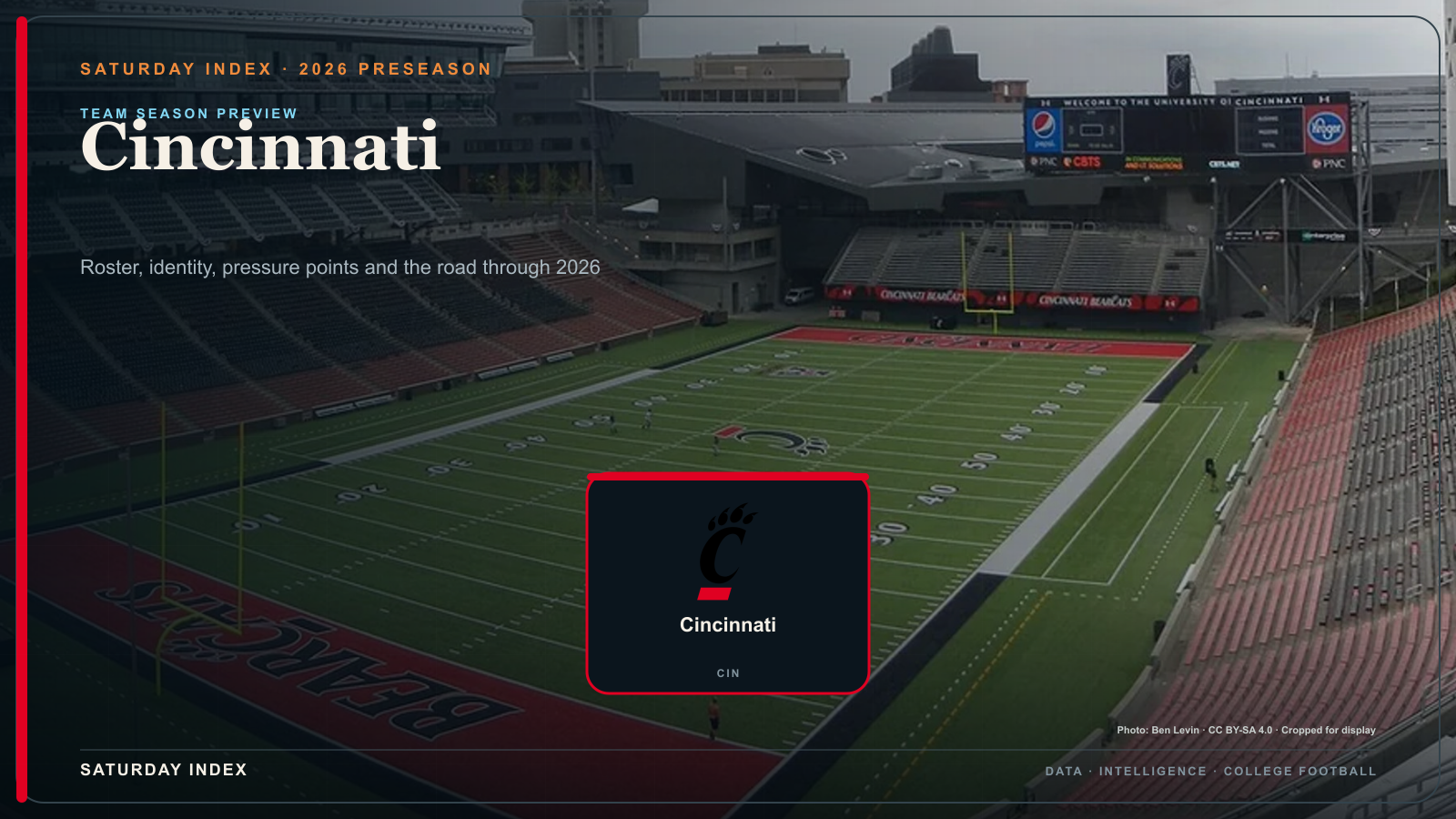
Cincinnati enters Scott Satterfield’s fourth season with a useful answer to one question and significant work left on several others. The Bearcats know what should carry them: an experienced offensive line, a flexible rushing structure and continuity under Satterfield and co-offensive coordinators Nic Cardwell and Pete Thomas. Their season will turn on how quickly a new quarterback, rebuilt receiving group and first-year defensive coordinator Nate Woody can make that foundation count.
Original season forecast
The original Big 12 forecast, retained alongside current results.
Big 12 projected standing
#15
3-6 projected · 2.9 expected conference wins · #15 of 16.
Preseason baseline
2025 percentiles retained as preseason context; current results and player production lead this page.
2025 FBS percentile scale · 50 is average
Incoming class
National and conference recruiting ranks, confirmed commitments, and the highest-ranked recruits in this class.
Top committed recruits
Cincinnati2026 transfer movement
Incoming and outgoing transfer activity, with rated FBS-to-FBS moves below.
Incoming Transfers
CincinnatiOutgoing Transfers
CincinnatiSeason schedule
Completed games show final results. Upcoming games use this week’s forecast where available; later games retain their published season outlook.
Detailed football intelligence
The full team identity, offense, defense, and supporting evidence.
Team identity
Last season, Cincinnati tried to stay balanced between the run and pass; the approach consistently kept the offense on schedule.
Why it matters
The run game was Cincinnati's steadier way to stay ahead of the chains; opponents have to win early fits without handing away play action.
 vs. Texas Tech
Pregame 19–36
Game detailsPregame comparisons use preserved published forecasts. Results include wins and losses.
At a glance
Current form leads the outlook.
2026 rates aggregate verified completed-game box scores. EPA is expected points added per play.
| Player | C/ATT | YDS | TD | INT |
|---|---|---|---|---|
| JC French | 107/151 | 1321 | 9 | 0 |
| Liam O'Brien | 5/5 | 18 | 0 | 0 |
| Samaj Jones | 2/2 | 9 | 0 | 0 |
| Player | CAR | YDS | AVG | TD |
|---|---|---|---|---|
| Cole Tabb | 46 | 445 | 9.7 | 8 |
| Gi'Bran Payne | 66 | 381 | 5.8 | 2 |
| JC French | 62 | 244 | 3.9 | 5 |
| Player | REC | YDS | AVG | TD |
|---|---|---|---|---|
| JaVonnie Gibson | 24 | 325 | 13.5 | 3 |
| Malachi Henry | 8 | 266 | 33.3 | 1 |
| Isaiah Johnson | 24 | 227 | 9.5 | 1 |
| Player | TOT | SOLO | TFL | SACK |
|---|---|---|---|---|
| Jonathan Thompson | 47 | 24 | 3.5 | 1 |
| Antwan Peek Jr. | 43 | 24 | 2.5 | 1.5 |
| Jasper Beeler | 41 | 22 | 2.5 | 0 |
Saturday, October 24 · Nippert Stadium
Saturday, October 17 · Milan Puskar Stadium
Saturday, October 3 · Arizona Stadium
The offensive line is Cincinnati’s most bankable unit. Joe Cotton, Evan Tengesdahl and Taran Tyo return from a 2025 group that Cincinnati reported allowed eight sacks and 43 tackles for loss, both the fewest in the Power Four. The Bearcats also finished third nationally at 5.7 rushing yards per carry. Tyo’s expected move from guard to center adds flexibility to an interior built to protect a new quarterback and preserve the offense’s most reliable identity.
There is individual distinction within that continuity. Tengesdahl earned 2025 AP third-team All-America recognition, and he and Cotton were selected for the 2026 preseason All-Big 12 team. Cincinnati reported that Cotton did not allow a sack last season. Those credentials make the line more than a safety net; it is the unit capable of setting the terms for the offense while the skill-position hierarchy develops.
Georgia Southern transfer JC French IV entered August with the strongest practical claim to the quarterback job. According to Dan Hoard, French completed about 70 percent of his spring-practice passes and threw four touchdowns without a turnover across two reported scrimmages. Cincinnati had not formally named a Week 1 starter, but French’s experience and early command separated him from a room that otherwise features Penn transfer Liam O’Brien and returning redshirt sophomore Samaj Jones. Both alternatives bring designed-run value, while Jones has only seven career pass attempts.
That quarterback profile fits an offense equipped to spread rushing work across several players. Notre Dame transfer and Cincinnati native Gi’Bran Payne joined a spring rotation in which Zion Johnson and transfer Zylan Pery also generated scores or explosive plays. Rather than depending on one established lead back, Cincinnati can pair multiple rushing and receiving options with the quarterback-run element and let the offensive line remain the organizing force.
The passing game carries greater replacement pressure. Malachi Henry delivered the strongest spring signal among the transfer receivers, producing three total touchdowns in the April 4 scrimmage and adding a 50-yard reception April 10. Oklahoma transfer JV Gibson also caught a touchdown from French, while returning tight end Gavin Grover caught scores from French and Jones. Those connections give Cincinnati plausible answers after losing its leading 2025 receiving group, but spring production has not yet determined the regular-season target order.
Woody’s arrival makes defense the larger structural change. Hoard reported that Woody coordinated the AAC’s top-ranked defense at Army in each of the previous two seasons, and Satterfield has said Cincinnati wants to apply more pressure to opposing quarterbacks. The objective is straightforward: create disruption up front and deny quarterbacks the clean operating conditions that can expose a defense still adjusting its roles.
Antwan Peek Jr. is the clearest player around whom to build that approach. Cincinnati described Peek as the Big 12’s highest-graded safety by PFF in 2025, and Woody is moving him closer to the line of scrimmage. The change can put Cincinnati’s most established defensive playmaker nearer the run game and pressure action. It also raises the importance of how the Bearcats redistribute coverage responsibilities behind him.
The schedule gives those new arrangements an early chance to take hold. Boston College and Western Carolina visit Nippert Stadium before Cincinnati meets Miami (Ohio) at TQL Stadium, and Kansas State follows at Nippert. Arizona is the Bearcats’ only trip outside Cincinnati before an Oct. 17 game at West Virginia. That geography increases the value of establishing French’s timing with his receivers and clarifying Woody’s defensive rotation before travel becomes a larger part of the season.
The later pressure points are unmistakable. Reigning Big 12 champion Texas Tech, Utah and Colorado join Kansas State on the home conference slate, while three of the final four games require trips to Houston, Iowa State and BYU. Cincinnati’s strongest formula is to let its line and rushing game provide immediate stability while French, the new receiving options and Woody’s defense develop around them. The final quarterback order, skill-position distribution, defensive first units and game-day availability still require clarification, but the central test is already visible: the Bearcats must turn continuity up front into cohesion everywhere else before the schedule’s early runway gives way to its demanding finish.
This preview is based on the linked public reporting and official program records.
Profile high point
The run game held the profile's highest percentile position.Profile low point
Pressure held the lowest percentile position among the profile's strength measures.



The run game is what Cincinnati can trust most.
Why it matters
The offense has its best route to favorable third downs and a credible play-action menu; front-seven disruption remains the first counter an opponent should test.
Front-seven disruption is Cincinnati's biggest concern, and opponents can test it immediately.
Why it matters
Opponents can trust normal protection and make the defense win without steady negative plays; rushing structure has to keep that stress from setting the game plan.
Cincinnati is at its best when it can stay balanced between the run and pass, then let the run game finish drives; fewer possessions make every empty drive more expensive.
Why it matters
Cincinnati's clean script is to stay ahead with early-down runs, draw an extra defender into the box, and then use play action; defenses will try to force obvious passing downs. In a slower game, one empty drive or failed early-down series carries extra weight.
Inside the team
Open a section for the football detail and supporting numbers.
The down-to-down question that determines whether the offense can keep both the run and pass available.
Opponents have to keep Cincinnati's run game from turning first down into second-and-manageable.
Why it matters
If Cincinnati stays on schedule on the ground, the offense keeps more answers available.
The pace, play selection, and methods this offense uses to stay on schedule.
Cincinnati played at a deliberate pace in 2025.
What matters
Cincinnati worked with fewer possessions than most teams last season.
Cincinnati's prior passing record was top-tier.
Why it matters
A repeatable pass game can let Cincinnati punish loaded boxes without relying on low-frequency deep completions.
Why it matters
A sustainable run game keeps Cincinnati's play action credible and limits obvious passing situations.
Cincinnati both created and limited explosive plays at a strong prior-season level.
Why it matters
That combination can change a game without forcing the offense to trade efficiency for low-percentage shots.
How consistently the offense creates manageable situations and the defense prevents them.
Cincinnati's offense was more consistent down to down than its defense.
Why it matters
Cincinnati's success rate shows whether it can sustain drives and get stops without relying on sacks, turnovers, or isolated big plays.
Cincinnati's opponent-adjusted passing and rushing value were closely matched.
Why it matters
When the split is narrow, early-down execution matters more than steering the offense toward one obvious weakness.
Where the defense can create pressure, control the run, and end drives.
Cincinnati's prior defense was bottom-tier overall and strongest in pass defense.
Why it matters
Opponents can trust normal protection and make coverage hold through the route; Cincinnati needs its pass defense to tighten throwing windows before that plan settles in.
Cincinnati's available disruption measures ranked near the bottom nationally last season; a charted pressure rate is not available.
Why it matters
Without consistent disruption, Cincinnati's defense must win more snaps through coverage, leverage, and early-down prevention.
Cincinnati's sack production outpaced its broader disruption record.
Why it matters
Cincinnati's disruption can hurry an offense; sacks do more by erasing field position and ending passing downs.
Cincinnati's prior run-defense results were bottom-tier.
Why it matters
If Cincinnati's front cannot control early downs, opponents can keep every offensive option open and protect their passing game.