Week 5 · FinalL
 at UNLV
31–39-8 margin
Pregame 26–27
Game detailsSaturday Index
Loading team intelligenceBringing the latest verified football information into focus.
ACC · 2026 · Week 8

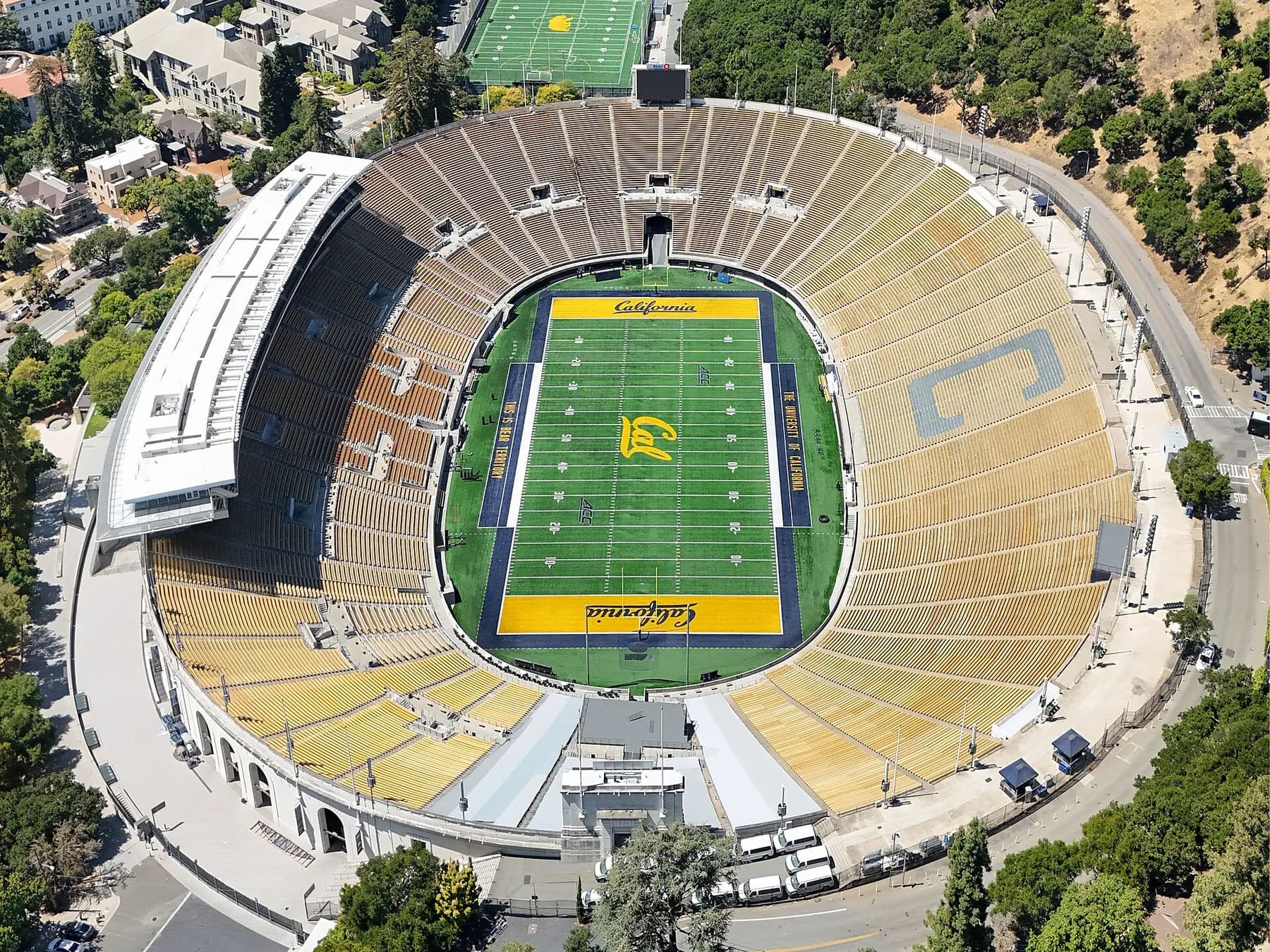
Photo: Quintin Soloviev · CC BY 4.0 · Cropped for display
Up next · Week 9
Away
On the road at
Saturday, October 31 · Time TBA
The season, taking shape
Final scores show California first. Oldest to newest.
at UNLVPregame 26–27
Game details vs. Virginia Tech
Pregame 26–29
Game details vs. Wake Forest
Pregame 24–31
Original full-season forecast
This forecast retains the original probabilities for the full schedule. It does not update with completed results or this week’s forecast.
2026 results
Current record, team efficiency, player production, and verified results from completed games.
Current record
3-53 wins · 5 lossesThrough 8 completed gamesLoading player usage…
2026 season preview
California's 2026 season turns on a useful imbalance: The Bears have continuity at the sport's most important position and change almost everywhere around it. First-year coach Tosh Lupoi inherits Jaron-Keawe Sagapolutele, a proven high-volume passer, while integrating 50 newcomers. Cal has assembled recognizable options across the roster. The harder task is making those pieces function together before the schedule begins applying pressure.
THE RESET — New leadership extends across every phase. Jordan Somerville leads the offense, Cal lists Da'Von Brown and Michael Hutchings as defensive coordinators, and Zach Tinker handles special teams. Of the 50 newcomers announced by the school, 32 arrived through the portal and 40 enrolled for spring. That early time together matters for a roster whose ceiling will depend less on the number of additions than on how quickly responsibilities become clear.
Original season forecast
The original ACC forecast, retained alongside current results.
ACC projected standing
#10
4-5 projected · 4.4 expected conference wins · #10 of 17.
Preseason baseline
2025 percentiles retained as preseason context; current results and player production lead this page.
2025 FBS percentile scale · 50 is average
Incoming class
National and conference recruiting ranks, confirmed commitments, and the highest-ranked recruits in this class.
Top committed recruits
California2026 transfer movement
Incoming and outgoing transfer activity, with rated FBS-to-FBS moves below.
Incoming Transfers
CaliforniaOutgoing Transfers
CaliforniaSeason schedule
Completed games show final results. Upcoming games use this week’s forecast where available; later games retain their published season outlook.
Detailed football intelligence
The full team identity, offense, defense, and supporting evidence.
Team identity
Last season, California tried to lean on the passing game; it rarely provided an easy foundation.
Why it matters
The passing game was California's more workable option, not an established edge; defenses can begin balanced until routine throws force an adjustment.
 at SMU
Pregame 19–36
Game detailsPregame comparisons use preserved published forecasts. Results include wins and losses.
At a glance
Current form leads the outlook.
2026 rates aggregate verified completed-game box scores. EPA is expected points added per play.
| Player | C/ATT | YDS | TD | INT |
|---|---|---|---|---|
| Jaron-Keawe Sagapolutele | 149/219 | 1555 | 10 | 5 |
| Jackson Brousseau | 75/120 | 701 | 3 | 0 |
| Mason Mini | 1/1 | 26 | 0 | 0 |
| Player | CAR | YDS | AVG | TD |
|---|---|---|---|---|
| Adam Mohammed | 73 | 336 | 4.6 | 3 |
| Ashten Emory | 73 | 232 | 3.2 | 4 |
| Carson Perry-Smith | 10 | 34 | 3.4 | 0 |
| Player | REC | YDS | AVG | TD |
|---|---|---|---|---|
| Chase Hendricks | 54 | 498 | 9.2 | 3 |
| Ian Strong | 33 | 467 | 14.2 | 1 |
| Mason Mini | 21 | 220 | 10.5 | 2 |
| Player | TOT | SOLO | TFL | SACK |
|---|---|---|---|---|
| Isaiah Crosby | 44 | 29 | 2 | 0 |
| AJ Tuitele | 40 | 17 | 4.5 | 3 |
| Kingston Lopa | 37 | 29 | 1 | 0 |
Saturday, October 24 · Gerald J. Ford Stadium
Saturday, October 17 · California Memorial Stadium
Saturday, October 10 · California Memorial Stadium
THE FOUNDATION — Sagapolutele completed 316 of 492 passes for 3,454 yards, 18 touchdowns and nine interceptions in 13 games as a freshman in 2025. Cal therefore begins with a quarterback who has already managed a full season's workload. His experience gives Somerville a stable starting point while the new staff decides how best to arrange the backs, receivers and tight ends around him.
California Golden Bears On SI projects Washington transfer Adam Mohammed to lead the backfield, with UC Davis transfer Carter Vargas the leading second option after averaging 6.6 yards per carry in 2025. The outlet projects Rutgers transfer Ian Strong and 2025 second-team All-MAC selection Chase Hendricks outside, with Oregon transfer Cooper Perry the leading slot candidate. Strong's 54 catches last season give Sagapolutele a prospective target with recent volume, while a productive backfield rotation could keep defenses from treating Cal as a pass-only offense.
Tight end may offer Somerville his most valuable flexibility. New Mexico transfer Dorian Thomas arrives after earning first-team All-Mountain West recognition, while Mason Mini's 35 catches make him Cal's leading returning receiver. Those options could support conventional three-receiver formations or two-tight-end packages that add protection and run leverage. Somerville has not previously been a college offensive coordinator, and his base structure had not been established before camp, so personnel usage will be an early clue to his priorities.
THE PRESSURE POINT — The offensive line will determine how much of that flexibility Cal can use. Tyson Ruffins and Sioape Vatikani supply returning experience at guard, but center and both tackle alignments remain unsettled. California Golden Bears On SI identified Jimothy Lewis Jr. as the likely right tackle, an especially important job because that side protects the left-handed Sagapolutele's blind side. Tight ends and formation choices can provide help; dependable tackle play remains essential to building around the offense's best-established player.
THE DEFENSIVE BUILD — California Golden Bears On SI expects Cal to resemble the structure Lupoi used at Oregon, commonly featuring two down linemen, two edge players and five defensive backs, with labels changing by matchup. That multiplicity can disguise pressure and coverage. It also places a premium on disciplined run fits from a front seven undergoing substantial change.
Jericho Johnson, Nate Burrell and Derek Wilkins are the leading down-line candidates, though no combination was considered settled. Burrell missed 2025 after making 21 starts over the previous three seasons, making his return potentially important to the interior. At inside linebacker, transfers Tristan Jernigan and AJ Tuitele are projected as the favorites, with Aaron Hampton and Kamar Mothudi also competing after 2025 starters Cade Uluave and Luke Ferrelli departed. That room must replace both tackling and communication experience.
The secondary carries similar uncertainty. Ole Miss transfer Ricky Fletcher is the clearest projected starter, while Marquis Groves-Killebrew and Daniel Harris compete at the other corner. Kingston Lopa, Aiden Manutai and Isaiah Crosby are among the safety contenders, with Crosby returning from injury and his final readiness not yet established. Because Cal is expected to use five defensive backs frequently, resolving the corner, safety and nickel combinations will be central to avoiding communication errors.
THE OPENING TEST — Cal starts at home against UCLA, travels across the country to Syracuse in Week 2, hosts Wagner and then welcomes Clemson for a Friday-night ACC game. The sequence gives the Bears little room for a gradual introduction: a rivalry opener, immediate eastern travel and a major conference test all arrive in September. Wagner separates Syracuse from Clemson, but the broader demand is clear—the new staff must establish working combinations quickly.
Sagapolutele gives Lupoi a firmer foundation than most first-year coaches inherit. Mohammed, Strong, Hendricks, Thomas and Mini offer plausible ways to support the quarterback, and Lupoi's expected defensive structure supplies a clear conceptual direction. The season's defining questions are more practical than theoretical: whether the line can protect Sagapolutele and whether the reconstructed defense can communicate well enough to turn multiplicity into an advantage. Cal's talent has recognizable shape; cohesion will determine what that shape means on the field.
This preview is based on the linked public reporting and official program records.
Profile high point
Big-play prevention held the profile's highest percentile position.Profile low point
The run game held the lowest percentile position among the profile's strength measures.



California did not have one unit that could carry the whole game plan; big-play creation came closest.
What matters
Even California's best unit finished near the national middle last season, leaving no proven strength to build around.
The run game is California's biggest concern, and opponents can test it immediately.
What matters
California's rushing structure ranked near the bottom nationally last season.
For California, the cleanest script is to use the passing game to stay on schedule and finish drives; extra possessions give that plan time to build.
What matters
California's pass-first structure played at a fast pace. The pass game finished middle-of-the-pack, while the run game finished bottom-tier.
Inside the team
Open a section for the football detail and supporting numbers.
The down-to-down question that determines whether the offense can keep both the run and pass available.
The first question for California is whether its passing rhythm can force defenses to adjust.
What matters
Routine completions are the most workable route to manageable third downs, not an established advantage.
The pace, play selection, and methods this offense uses to stay on schedule.
California played at a fast pace in 2025.
Why it matters
More possessions give California's strengths additional chances to build, but they also leave more time to recover from mistakes.
California's prior passing record was middle-of-the-pack.
Why it matters
California's offense needs protection, field position, or explosive variance when ordinary dropbacks do not create enough value.
California's prior rushing record was bottom-tier.
Why it matters
When California's run game cannot stay on schedule, protection and passing-down execution carry more of the offense.
California's explosive-play results were mixed rather than a defining edge.
Why it matters
A big play can still flip a possession, but last season's results do not make explosiveness something this team can rely on.
How consistently the offense creates manageable situations and the defense prevents them.
California's down-to-down results were below-average overall.
Why it matters
California's success rate shows whether it can sustain drives and get stops without relying on sacks, turnovers, or isolated big plays.
Opponent-adjusted EPA identifies the pass game as California's stronger offensive unit.
Why it matters
If an opponent removes the first passing answer, the run game's lower adjusted value becomes the key counter to test.
Where the defense can create pressure, control the run, and end drives.
California's prior defense was below-average overall and strongest in pass defense.
Why it matters
Opponents can test the fits early enough to keep every offensive option open; California needs its pass defense to tighten throwing windows before that plan settles in.
California's available disruption measures ranked in the lower national range last season; a charted pressure rate is not available.
Why it matters
Without consistent disruption, California's defense must win more snaps through coverage, leverage, and early-down prevention.
California's sack and disruption results were weak.
Why it matters
California's disruption can hurry an offense; sacks do more by erasing field position and ending passing downs.
California's prior run-defense results were bottom-tier.
Why it matters
If California's front cannot control early downs, opponents can keep every offensive option open and protect their passing game.