
Week 5 · FinalW
 at TCU
17–10+7 margin
Pregame 28–22
Game detailsSaturday Index
Loading team intelligenceBringing the latest verified football information into focus.
Big 12 · 2026 · Week 8

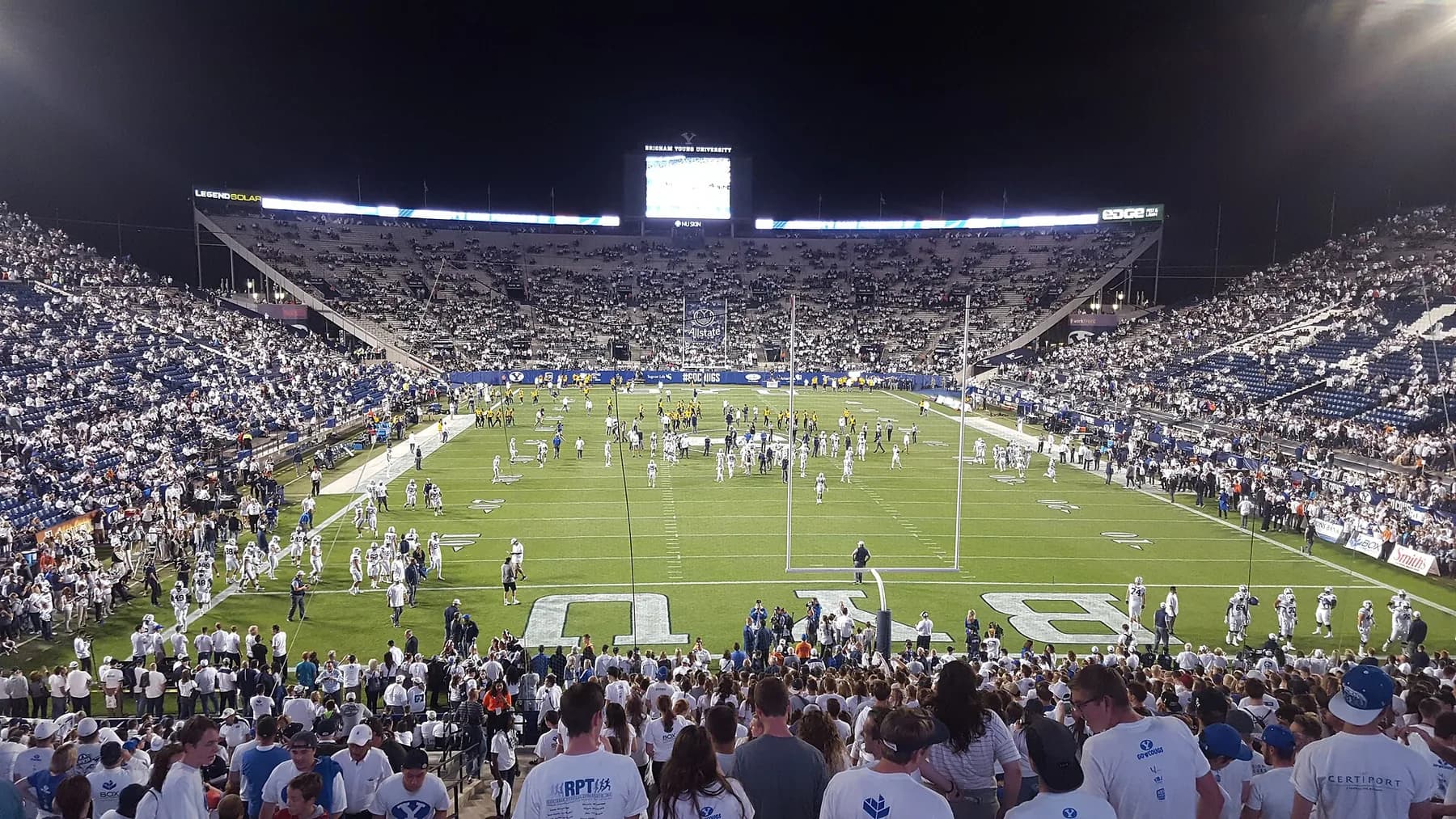
Photo: Dalee Despain · CC BY-SA 4.0 · Cropped for display
Up next · Week 9
Home
Hosting
Saturday, October 31 · Time TBA
The season, taking shape
Final scores show BYU first. Oldest to newest.
at TCUPregame 28–22
Game details vs. Iowa State
Pregame 31–19
Game details vs. Notre Dame
Pregame 19–31
Game detailsOriginal full-season forecast
This forecast retains the original probabilities for the full schedule. It does not update with completed results or this week’s forecast.
2026 results
Current record, team efficiency, player production, and verified results from completed games.
Current record
6-16 wins · 1 lossThrough 7 completed gamesLoading player usage…
2026 season preview
Bear Bachmeier, LJ Martin and veteran lines give BYU a sturdy foundation, but receiver turnover, injury recoveries and Kelly Poppinga's defensive transition will shape the Cougars' season.
BYU's 2026 outlook rests on continuity without complacency. Kalani Sitake retained the core of a 12-win team, giving the Cougars an established quarterback, an award-winning running back, veteran lines and experienced defenders at every level. Aaron Roderick continues to direct the offense, while Kelly Poppinga takes charge of a defense he wants to advance without discarding its foundation. That stability gives BYU reason for substantial expectations, but receiver turnover, several injury recoveries and a demanding schedule will test how much the returning nucleus can absorb.
Original season forecast
The original Big 12 forecast, retained alongside current results.
Big 12 projected standing
#3
7-2 projected · 6.4 expected conference wins · #3 of 16.
Preseason baseline
2025 percentiles retained as preseason context; current results and player production lead this page.
2025 FBS percentile scale · 50 is average
Incoming class
National and conference recruiting ranks, confirmed commitments, and the highest-ranked recruits in this class.
Top committed recruits
BYU2026 transfer movement
Incoming and outgoing transfer activity, with rated FBS-to-FBS moves below.
Incoming Transfers
BYUOutgoing Transfers
BYUSeason schedule
Completed games show final results. Upcoming games use this week’s forecast where available; later games retain their published season outlook.
Detailed football intelligence
The full team identity, offense, defense, and supporting evidence.
Team identity
Last season, BYU tried to lean on the running game; the approach consistently kept the offense on schedule.
Why it matters
The run game was BYU's steadier way to stay ahead of the chains; opponents have to win early fits without handing away play action.
 at UCF
Pregame 29–18
Game detailsPregame comparisons use preserved published forecasts. Results include wins and losses.
At a glance
Current form leads the outlook.
2026 rates aggregate verified completed-game box scores. EPA is expected points added per play.
| Player | C/ATT | YDS | TD | INT |
|---|---|---|---|---|
| Bear Bachmeier | 100/152 | 1257 | 9 | 2 |
| Kyler Kasper | 1/1 | 15 | 1 | 0 |
| Treyson Bourguet | 1/3 | 15 | 0 | 1 |
| Player | CAR | YDS | AVG | TD |
|---|---|---|---|---|
| LJ Martin | 44 | 344 | 7.8 | 3 |
| Bear Bachmeier | 49 | 284 | 5.8 | 6 |
| Journee Tonga | 30 | 182 | 6.1 | 2 |
| Player | REC | YDS | AVG | TD |
|---|---|---|---|---|
| Legend Glasker | 24 | 444 | 18.5 | 3 |
| Kyler Kasper | 20 | 244 | 12.2 | 3 |
| Walker Lyons | 18 | 199 | 11.1 | 1 |
| Player | TOT | SOLO | TFL | SACK |
|---|---|---|---|---|
| Cade Uluave | 35 | 22 | 3.5 | 0.5 |
| Faletau Satuala | 28 | 14 | 2 | 0 |
| Tommy Prassas | 20 | 15 | 0.5 | 0 |
Saturday, October 24 · FBC Mortgage Stadium
Saturday, October 17 · LaVell Edwards Stadium
Friday, October 9 · LaVell Edwards Stadium
The offense starts with sophomore Bear Bachmeier, the established QB1 after leading BYU to 12 wins as a true freshman. His experience in Roderick's system should let the Cougars build rather than reset, and his rushing ability forces defenses to account for him beyond the pocket. It also exposes him to additional contact. Senior Treyson Bourguet and freshman Enoch Watson remained in an unresolved competition for the backup role after spring, leaving BYU with less certainty behind Bachmeier than it has at starter. His health and growth as a passer are central to the entire season.
LJ Martin supplies the offense's clearest identity. Roderick said BYU intends to give the reigning Big 12 Offensive Player of the Year roughly 20 carries per game, with Sione Moa capable of sharing the field and Devaughn Eka pushing for work. Martin missed spring after December shoulder surgery, however, and Jovesa Damuni sustained a serious spring injury. Their timelines remained unclear entering this preview. A veteran line led by All-American center Bruce Mitchell, Andrew Gentry, Kyle Sfarcioc and Sonny Makasini is built to support the run-first plan, although Makasini's return from noncontact work is another health point to watch.
The greatest offensive uncertainty is at receiver. BYU must replace Chase Roberts, Carsen Ryan and Parker Kingston, then lost projected contributor Cody Hagen to medical retirement. JoJo Phillips and Tei Nacua bring talent but less established production, while Oregon transfer Kyler Kasper offers another possible answer. Their development will help determine whether Bachmeier can turn the passing game into a dependable complement to Martin. Transfers Walker Lyons from USC and Roger Saleapaga II from Oregon give Roderick experienced tight ends who can reinforce the running game and provide bigger intermediate targets while the receiver rotation settles.
Poppinga inherits enough defensive continuity to evolve rather than rebuild. Keanu Tanuvasa, Anisi Purcell and Justin Kirkland anchor the interior, with Bodie Schoonover, Viliami Po'uha, Tausili Akana and Nusi Taumoepeau returning on the edges. BYU did not seek transfer help for the front, reflecting confidence in its depth, and Tanuvasa's role as a captain gives the transition an established leader. The challenge for Poppinga is to add pressure and disguise without sacrificing the communication, run defense and takeaway potential that powered the unit in 2025.
Linebacker and the secondary offer both proven pieces and unresolved questions. Cal transfer Cade Uluave joins Isaiah Glasker and Siale Esera, and Poppinga praised Uluave's daily playmaking during spring. Glasker missed spring with an injury and was expected back within weeks of an April update, but his readiness for full-contact work was not established. BYU also told The Salt Lake Tribune that Ephraim Asiata's team status was under evaluation after a DUI charge reported July 29, so his availability cannot yet be assumed. Behind them, All-American safety Faletau Satuala and veteran corner Evan Johnson lead an experienced secondary that also returns Raider Damuni and Tre Alexander and adds Mississippi State transfer Jayven Williams.
The schedule gives BYU an opening sequence against Utah Tech and Arizona at home before a trip to Colorado State. Pressure rises sharply in October: the Cougars visit TCU, host Iowa State and Notre Dame, travel to UCF and return home for Arizona State. November brings the rivalry trip to Utah, followed by Baylor at home, Kansas on the road and Cincinnati in the finale. That stretch will demand more than star power; it will test the backup quarterback, the running-back rotation, the rebuilt receiving corps and Poppinga's ability to adjust from week to week.
BYU does not need a wholesale transformation to make 2026 meaningful. It needs Bachmeier to progress, Martin and the offensive line to emerge healthy, new targets to become reliable and Poppinga's changes to strengthen rather than unsettle an experienced defense. Mitchell, Tanuvasa, Uluave and Satuala give the Cougars consequential players through the middle of the roster, while Sitake's emphasis on retention and veteran leadership provides organizational steadiness. A precise record forecast would overstate what is known, but the season's dividing line is clear: BYU has a strong foundation, and its depth must now prove sturdy enough for the schedule ahead.
This preview is based on the linked public reporting and official program records.
Profile high point
The run game held the profile's highest percentile position.Profile low point
Big-play creation held the lowest percentile position among the profile's strength measures.




The offense's down-to-down consistency is what BYU can trust most.
What matters
BYU's offensive efficiency ranked in a strong national range last season.
Big-play creation is BYU's biggest concern, and opponents can test it immediately.
Why it matters
Opponents can squeeze underneath space and make the offense finish long drives without chunk gains; offensive efficiency has to keep that stress from setting the game plan.
BYU's best path is to use the running game to control early downs and finish drives; an average pace puts more weight on winning ordinary downs.
What matters
BYU's run-leaning structure played at a balanced pace. The run game finished strong, while the pass game finished above-average.
Inside the team
Open a section for the football detail and supporting numbers.
The down-to-down question that determines whether the offense can keep both the run and pass available.
Opponents have to keep BYU's run game from turning first down into second-and-manageable.
Why it matters
If BYU stays on schedule on the ground, the offense keeps more answers available.
The pace, play selection, and methods this offense uses to stay on schedule.
BYU played at a balanced pace in 2025.
Why it matters
At that pace, BYU cannot count on extra possessions or expect to shorten the game.
BYU's prior passing record was above-average.
Why it matters
A repeatable pass game can let BYU punish loaded boxes without relying on low-frequency deep completions.
BYU's prior rushing record was strong.
Why it matters
A sustainable run game keeps BYU's play action credible and limits obvious passing situations.
BYU's explosive-play results were mixed rather than a defining edge.
Why it matters
A big play can still flip a possession, but last season's results do not make explosiveness something this team can rely on.
How consistently the offense creates manageable situations and the defense prevents them.
BYU won ordinary downs on both sides of the ball.
Why it matters
BYU's success rate shows whether it can sustain drives and get stops without relying on sacks, turnovers, or isolated big plays.
BYU's opponent-adjusted passing and rushing value were closely matched.
Why it matters
When the split is narrow, early-down execution matters more than steering the offense toward one obvious weakness.
Where the defense can create pressure, control the run, and end drives.
BYU's prior defense was strong overall and strongest in run front.
Why it matters
Opponents can start with normal protection while remaining ready to adjust it; BYU's run front can still create long-yardage without overloading the box before that probe becomes dependable.
BYU's available disruption measures finished near the national middle last season; a charted pressure rate is not available.
Why it matters
Without consistent disruption, BYU's defense must win more snaps through coverage, leverage, and early-down prevention.
BYU's sack and disruption results were middle-of-the-pack.
Why it matters
BYU's disruption can hurry an offense; sacks do more by erasing field position and ending passing downs.
Why it matters
A dependable run front can let BYU create obvious passing downs without committing extra bodies to the box.