
Week 4 · FinalL
 vs. Virginia Tech
14–21-7 margin
Pregame 22–30
Game detailsSaturday Index
Loading team intelligenceBringing the latest verified football information into focus.
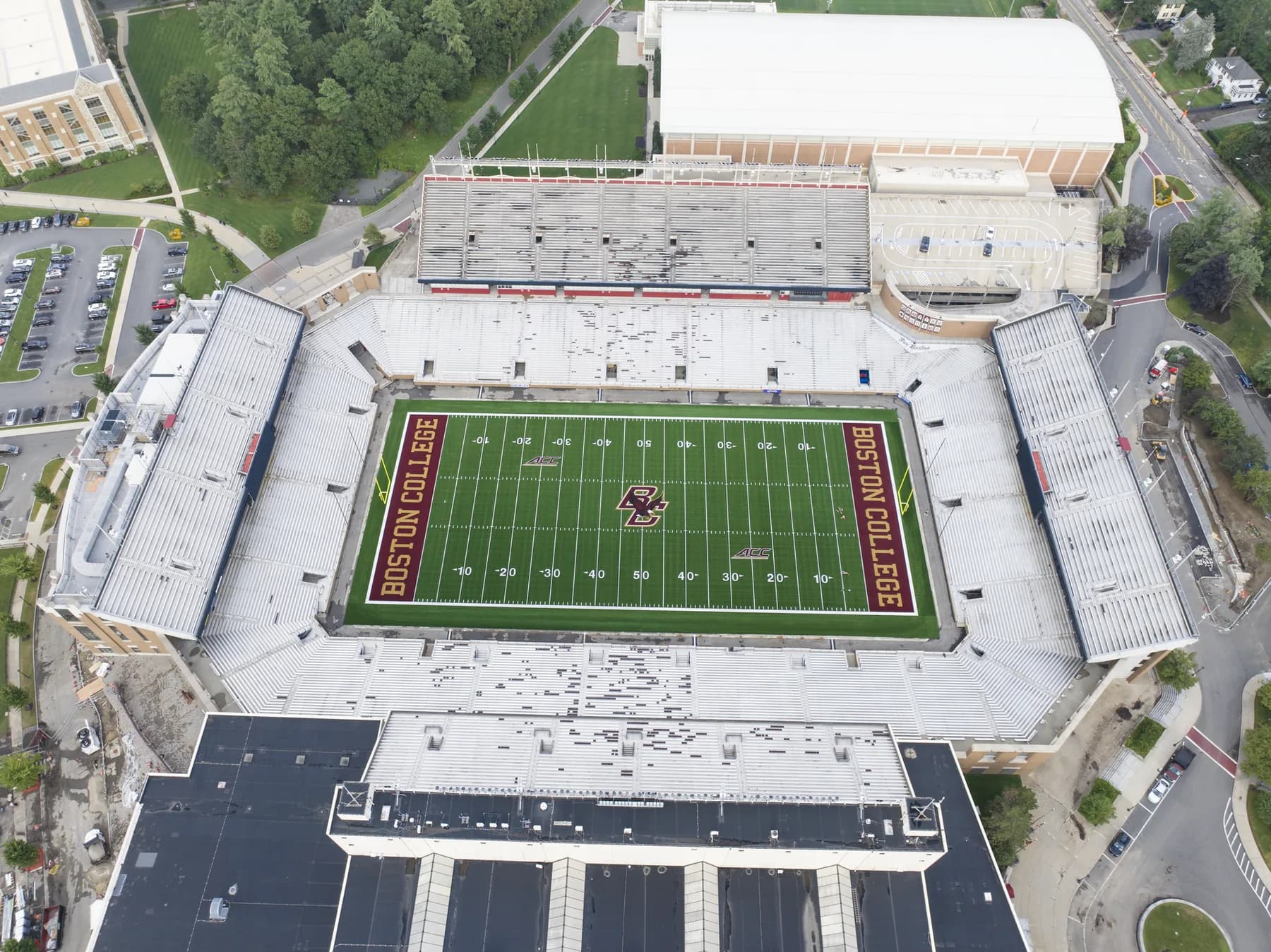
ACC · 2026 · Week 8
Photo: Quintinsoloviev · CC BY-SA 4.0 · Cropped for display
Up next · Week 9
Away
On the road at
Saturday, October 31 · Time TBA
The season, taking shape
Final scores show Boston College first. Oldest to newest.
vs. Virginia TechPregame 22–30
Game details at SMU
Pregame 18–38
Game details vs. Pittsburgh
Pregame 20–29
Original full-season forecast
This forecast retains the original probabilities for the full schedule. It does not update with completed results or this week’s forecast.
2026 results
Current record, team efficiency, player production, and verified results from completed games.
Current record
4-34 wins · 3 lossesThrough 7 completed gamesLoading player usage…
2026 season preview
Boston College enters 2026 in the middle of a portal-driven reset. Bill O'Brien has recognizable anchors at running back, tight end, kicker and in the secondary, but the Eagles officially added 26 transfers: 15 on offense, nine on defense and two specialists. The defining question is whether those newcomers can become functional units before a demanding schedule exposes every delay.
O'Brien remains both the head coach and the central offensive authority; Boston College does not list a separate offensive coordinator. That keeps quarterback development, scheme direction and weekly game planning tied directly to him. Ted Roof coordinates the defense after producing units at Oklahoma that generated takeaways, tackles for loss and third-down stops. His 2019 Appalachian State defense led the nation in defensive touchdowns, pointing toward an attacking approach that BC's reconstructed roster still must prove it can execute.
Original season forecast
The original ACC forecast, retained alongside current results.
ACC projected standing
#17
2-6 projected · 1.9 expected conference wins · #17 of 17.
Preseason baseline
2025 percentiles retained as preseason context; current results and player production lead this page.
2025 FBS percentile scale · 50 is average
Incoming class
National and conference recruiting ranks, confirmed commitments, and the highest-ranked recruits in this class.
Top committed recruits
Boston College2026 transfer movement
Incoming and outgoing transfer activity, with rated FBS-to-FBS moves below.
Incoming Transfers
Boston CollegeOutgoing Transfers
Boston CollegeSeason schedule
Completed games show final results. Upcoming games use this week’s forecast where available; later games retain their published season outlook.
Detailed football intelligence
The full team identity, offense, defense, and supporting evidence.
Team identity
Last season, Boston College tried to lean on the passing game; the results were uneven when the offense tried to live that way.
Why it matters
The passing game was Boston College's more dependable way to stay ahead of the chains; opponents have to interrupt that rhythm without giving the run an easy box.
 at Georgia Tech
Pregame 22–31
Game detailsPregame comparisons use preserved published forecasts. Results include wins and losses.
At a glance
Current form leads the outlook.
2026 rates aggregate verified completed-game box scores. EPA is expected points added per play.
| Player | C/ATT | YDS | TD | INT |
|---|---|---|---|---|
| Mason McKenzie | 100/171 | 1260 | 7 | 6 |
| Player | CAR | YDS | AVG | TD |
|---|---|---|---|---|
| Mason McKenzie | 113 | 597 | 5.3 | 5 |
| Evan Dickens | 65 | 298 | 4.6 | 4 |
| Bo MacCormack III | 44 | 204 | 4.6 | 4 |
| Player | REC | YDS | AVG | TD |
|---|---|---|---|---|
| Javarius Green | 25 | 267 | 10.7 | 1 |
| Landon Wright | 8 | 208 | 26.0 | 1 |
| Dawson Pough | 12 | 180 | 15.0 | 1 |
| Player | TOT | SOLO | TFL | SACK |
|---|---|---|---|---|
| Anthony Palano | 58 | 32 | 7.5 | 1.5 |
| KP Price | 51 | 32 | 1 | 0 |
| Marcus Upton | 43 | 31 | 1 | 0 |
Saturday, October 24 · Bobby Dodd Stadium
Saturday, October 17 · Alumni Stadium (Chestnut Hill, MA)
Saturday, October 3 · Gerald J. Ford Stadium
Quarterback and offensive-line cohesion are the largest offensive variables. Transfer Mason McKenzie is the clearest public front-runner after practicing with the first wave of newcomers and representing BC at ACC Kickoff, but the Eagles have not formally named a starter. Spring competition produced touchdown catches for Reed Swanson, Nedrick Boldin Jr., Johnathan Montague and Jackson Wade. Those flashes identify candidates rather than a dependable receiver order, and the first offensive-line combination also remains unclear.
The backfield offers a more established starting point. Liberty transfer Evan Dickens rushed for 1,339 yards and 16 touchdowns in 2025. Maryland transfer Nolan Ray and freshman Sedric Addison also produced explosive runs during the spring, giving BC alternatives rather than forcing the offense through one newcomer. If the line comes together, that depth could let O'Brien build the offense from the run game outward while the quarterback and receivers settle into their roles.
Tight end Kaelan Chudzinski should help give the passing game structure. He led all freshman tight ends nationally in 2025 with 24 catches and 313 yards and tied the freshman positional lead with four receiving touchdowns. That production makes him BC's most established returning target and a natural middle-of-field option for a new quarterback. Dickens and Chudzinski can provide the offense with an identity, but their value will depend on the blocking and perimeter passing around them.
Defense begins with continuity in the secondary. Captain KP Price has started 25 consecutive games and totaled 179 tackles, nine pass breakups and four interceptions over the last two seasons. Max Tucker adds 20 starts and three career interceptions. Their experience should give Roof an established communication core while other roles take shape. Anthony Palano's spring prominence and selection for ACC Kickoff suggest leadership expectations in the remade linebacker room, although they do not define his position or snap share.
The defensive front carries more projection. E'Lla Boykin returns after making 19 tackles with one sack in 2025, while transfers Christian Hudson and Alex DeGrieck are among the available line candidates. That gives new line coach Ben Albert pieces to arrange, not a proven rotation. Roof's preferred disruption will depend on whether this group can generate pressure and negative plays, and the first unit and primary pass-rush sources remain uncertain.
Luca Lombardo gives BC documented production on special teams. He made 16 of 17 field goals and all 35 extra points in 2025, earning Lou Groza semifinalist recognition after an injury-limited 2024. His accuracy could protect an offense still developing by turning stalled drives into points. Athlon's preseason all-conference recognition for Lombardo, Dickens, Chudzinski and Price captures the larger roster: several credible individual anchors surrounded by position groups that still have to establish themselves.
The schedule offers little patience. Boston College opens at Cincinnati on Sept. 5, then hosts Rutgers, Maine and Virginia Tech before visiting SMU. Pittsburgh follows at home, with trips to Georgia Tech and Duke before Florida State visits Chestnut Hill. The Eagles finish at Notre Dame, home against Syracuse and at Miami. BC is the only FBS program scheduled to face power-conference opposition in every game except Maine, putting immediate pressure on a rebuilt roster to mature quickly.
Boston College's best case starts with Dickens, Chudzinski and Lombardo translating proven production into weekly stability, while Price and Tucker organize the defense from the back. The risk is collective: a new quarterback, unsettled line combinations and numerous undefined roles must come together around them. The full injury picture and Week 1 availability also remain unclear. Without assuming those answers, the season turns on whether O'Brien and Roof can transform extensive turnover into a team that functions as more than a collection of individual strengths.
This preview is based on the linked public reporting and official program records.
Profile high point
Passing held the profile's highest percentile position.Profile low point
Big-play prevention held the lowest percentile position among the profile's strength measures.



The passing game is Boston College's best starting point, though front-seven disruption keeps it from carrying the plan alone.
What matters
Boston College's passing efficiency finished above the national average last season.
Front-seven disruption is Boston College's biggest concern, and opponents can test it immediately.
Why it matters
Opponents can trust normal protection and make the defense win without steady negative plays; passing efficiency has to keep that stress from setting the game plan.
For Boston College, the cleanest script is to use the passing game to stay on schedule and finish drives; an average pace puts more weight on winning ordinary downs.
What matters
Boston College's pass-first structure played at a balanced pace. The pass game finished above-average, while the run game finished weak.
Inside the team
Open a section for the football detail and supporting numbers.
The down-to-down question that determines whether the offense can keep both the run and pass available.
Opponents have to break Boston College's passing rhythm before it owns early downs.
Why it matters
If Boston College keeps finding routine completions, the defense cannot load the box or turn the rush loose.
The pace, play selection, and methods this offense uses to stay on schedule.
Boston College played at a balanced pace in 2025.
Why it matters
At that pace, Boston College cannot count on extra possessions or expect to shorten the game.
Boston College's prior passing record was above-average.
Why it matters
Boston College's offense needs protection, field position, or explosive variance when ordinary dropbacks do not create enough value.
Boston College's prior rushing record was weak.
Why it matters
When Boston College's run game cannot stay on schedule, protection and passing-down execution carry more of the offense.
Explosive plays were a two-way concern in Boston College's record last season.
Why it matters
That combination increases dependence on sustained drives while leaving little margin for a missed fit or coverage error.
How consistently the offense creates manageable situations and the defense prevents them.
Boston College's down-to-down results were middle-of-the-pack overall.
Why it matters
Boston College's success rate shows whether it can sustain drives and get stops without relying on sacks, turnovers, or isolated big plays.
Opponent-adjusted EPA identifies the pass game as Boston College's stronger offensive unit.
Why it matters
If an opponent removes the first passing answer, the run game's lower adjusted value becomes the key counter to test.
Where the defense can create pressure, control the run, and end drives.
Boston College's prior defense was weak overall and strongest in run front.
What matters
Run front finished middle-of-the-pack, while disruption finished bottom-tier; the latter is the first place an offense should test.
Boston College's available disruption measures ranked near the bottom nationally last season; a charted pressure rate is not available.
Why it matters
Without consistent disruption, Boston College's defense must win more snaps through coverage, leverage, and early-down prevention.
Boston College's sack and disruption results were bottom-tier.
Why it matters
Boston College's disruption can hurry an offense; sacks do more by erasing field position and ending passing downs.
Boston College's prior run-defense results were middle-of-the-pack.
Why it matters
If Boston College's front cannot control early downs, opponents can keep every offensive option open and protect their passing game.