Week 4 · FinalW
 vs. Colorado
23–13+10 margin
Pregame 32–23
Game detailsSaturday Index
Loading team intelligenceBringing the latest verified football information into focus.
Big 12 · 2026 · Week 8

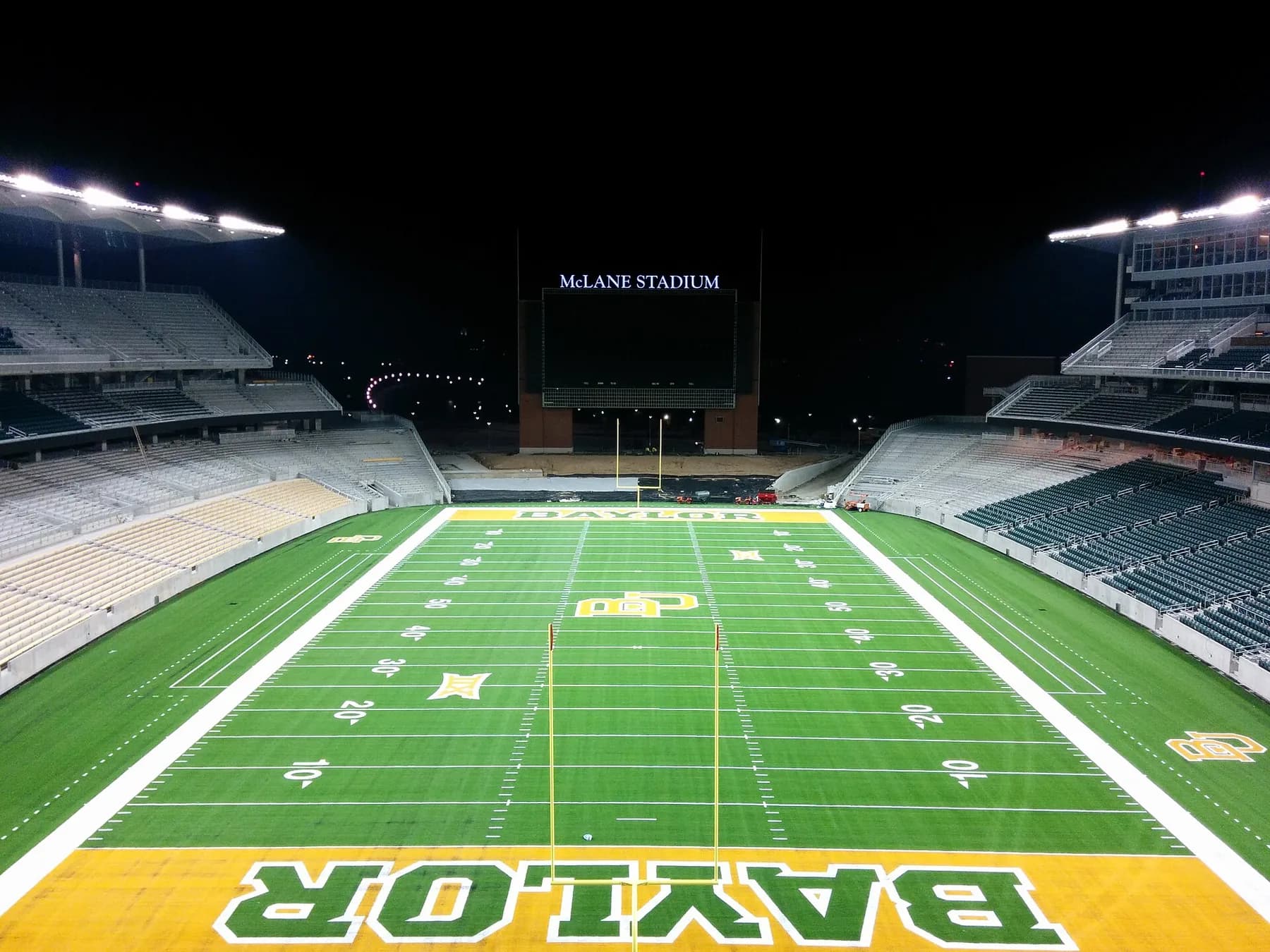
Photo: Djyueng · CC BY-SA 4.0 · Cropped for display
Up next · Week 9
Away
On the road at
Friday, October 30 · 7:30 PM EDT
The season, taking shape
Final scores show Baylor first. Oldest to newest.
vs. ColoradoPregame 32–23
Game details at Arizona State
Pregame 24–26
Game details vs. TCU
Pregame 27–24
Game detailsOriginal full-season forecast
This forecast retains the original probabilities for the full schedule. It does not update with completed results or this week’s forecast.
2026 results
Current record, team efficiency, player production, and verified results from completed games.
Current record
4-34 wins · 3 lossesThrough 7 completed gamesLoading player usage…
2026 season preview
DJ Lagway, two rebuilt lines and Joe Klanderman’s defensive reset put Baylor’s roster strategy under immediate pressure.
Baylor’s 2026 season is a test of Dave Aranda’s clearest roster bet: rebuild from the inside out and trust stronger lines to make every other position easier to organize. After emphasizing perimeter skill the previous year, Aranda said Baylor redirected resources toward the trenches. That choice defines the Bears more than any single newcomer. If the two rebuilt fronts settle quickly, Baylor can give a changing offense structure and a redesigned defense room to grow. If they do not, uncertainty elsewhere becomes much harder to manage.
Original season forecast
The original Big 12 forecast, retained alongside current results.
Big 12 projected standing
#10
4-5 projected · 3.8 expected conference wins · #10 of 16.
Preseason baseline
2025 percentiles retained as preseason context; current results and player production lead this page.
2025 FBS percentile scale · 50 is average
Incoming class
National and conference recruiting ranks, confirmed commitments, and the highest-ranked recruits in this class.
Top committed recruits
Baylor2026 transfer movement
Incoming and outgoing transfer activity, with rated FBS-to-FBS moves below.
Incoming Transfers
BaylorOutgoing Transfers
BaylorSeason schedule
Completed games show final results. Upcoming games use this week’s forecast where available; later games retain their published season outlook.
Detailed football intelligence
The full team identity, offense, defense, and supporting evidence.
Team identity
Last season, Baylor tried to lean on the passing game; the approach gave the offense a dependable starting point.
Why it matters
The run game was Baylor's steadier way to stay ahead of the chains; opponents have to win early fits without handing away play action.
 at Kansas
Pregame 25–29
Game detailsPregame comparisons use preserved published forecasts. Results include wins and losses.
At a glance
Current form leads the outlook.
2026 rates aggregate verified completed-game box scores. EPA is expected points added per play.
| Player | C/ATT | YDS | TD | INT |
|---|---|---|---|---|
| D.J. Lagway | 93/185 | 1120 | 8 | 3 |
| Nate Bennett | 46/61 | 568 | 5 | 2 |
| Edward Griffin | 1/5 | 7 | 0 | 1 |
| Player | CAR | YDS | AVG | TD |
|---|---|---|---|---|
| Dawson Pendergrass | 89 | 328 | 3.7 | 1 |
| Caden Knighten | 60 | 278 | 4.6 | 2 |
| Ryelan Morris | 30 | 206 | 6.9 | 1 |
| Player | REC | YDS | AVG | TD |
|---|---|---|---|---|
| Gavin Freeman | 49 | 555 | 11.3 | 2 |
| Louis Brown | 20 | 327 | 16.4 | 3 |
| Jayden McGowan | 8 | 197 | 24.6 | 3 |
| Player | TOT | SOLO | TFL | SACK |
|---|---|---|---|---|
| Travion Barnes | 35 | 26 | 3.5 | 1 |
| Micah Gifford | 30 | 20 | 2.5 | 0 |
| Kyland Reed | 25 | 20 | 4 | 1 |
Saturday, October 24 · Memorial Stadium
Saturday, October 17 · McLane Stadium
Saturday, October 3 · Mountain America Stadium
The scale of the turnover raises the difficulty. Baylor recorded 31 incoming transfers and 32 departures, with additions across every major unit. This is not a roster patching one isolated weakness; newcomers and returners must establish roles together throughout the team. The lines carry the greatest burden because they affect quarterback comfort, the shape of the running game and the freedom Joe Klanderman has to install his defense. Experience has arrived, but Baylor still has to turn that experience into cohesion.
Florida transfer DJ Lagway is the central offensive transition piece after Sawyer Robertson’s departure. Lagway worked as a junior quarterback at the opening spring practice under returning coordinator and quarterbacks coach Jake Spavital. His participation put him at the center of the conversation without settling how Baylor will order the quarterback room by September. Spavital’s return preserves terminology and teaching continuity, an advantage during a transition, but the offense still must learn how Lagway and the players around him fit together.
That process starts with a rebuilt offensive line. Returners Kaden and Koltin Sieracki are among the options alongside transfers Nate Kibble, Asher Hale, Yakiri Walker and Lawson Petty, but Baylor has not publicly settled on a starting five. The backfield also lacks a clear workload order among Caden Knighten, Michael Turner and Jacorey Watson. Jadon Porter returns at receiver, while Matthew Klopfenstein, Hawkins Polley and Florida transfer Tony Livingston give the quarterback veteran tight-end targets. The offense has usable pieces; its identity depends on the line creating enough stability for those roles to emerge.
The defense brings a more fundamental change. Klanderman, Baylor’s first-year coordinator and safeties coach, said the Bears intend to make considerable changes rather than preserve the previous approach. He coordinated Kansas State’s defense from 2020 through 2025, bringing sustained Big 12 experience to the reset. That background gives Aranda an experienced partner, but the early question is practical: how quickly can Klanderman teach a different system while determining which combinations work best?
Baylor invested most visibly in the defensive front, where veteran transfers Hosea Wheeler, Jamaal Whyce Jr., Kamren Washington, Jordan Mack and Zavion Hardy headline the rebuild identified by Aranda and safety Michael Allen. The group’s college experience matters, though its rotation still must develop chemistry at Baylor. Behind it, returners Kaleb Burns and Kyland Reed join transfer linebackers JJ Shelton and Kaleb Arterberry in a competition with unsettled roles. Allen provides a leadership bridge in the secondary, where experienced corner Reggie Bush II and young safety Bo Onu are among the options. An established all-conference-caliber punter could also help the defense through field position while the new combinations take shape.
The schedule offers little time for a gradual introduction. Baylor opens against Auburn at Mercedes-Benz Stadium on September 5, an immediate examination for both reconstructed lines. Home games against Prairie View A&M and Louisiana Tech follow before Colorado visits to begin Big 12 play. Those two intervening games give the Bears opportunities to refine combinations, but the opener ensures that the most important questions arrive before the roster has enjoyed much time together.
An October 10 open date precedes TCU’s visit, followed by trips to Kansas and UCF. The closing stretch brings another concentrated test: Baylor travels to BYU, hosts Texas Tech and finishes at Houston. By then, the quarterback order, offensive-line configuration, backfield workload and defensive rotations should have answers forged by competition, but none can be assumed now. Aranda has chosen to strengthen Baylor’s foundation first. The season will turn on whether those rebuilt lines become dependable enough for Lagway, Klanderman and the rest of the roster to benefit.
This preview is based on the linked public reporting and official program records.
Profile high point
Big-play prevention held the profile's highest percentile position.Profile low point
Pressure held the lowest percentile position among the profile's strength measures.



Baylor can lean on the run game when a drive slips off schedule, but front-seven disruption still needs support.
What matters
Baylor's rushing structure ranked in a strong national range last season.
Front-seven disruption is Baylor's biggest concern, and opponents can test it immediately.
Why it matters
Opponents can trust normal protection and make the defense win without steady negative plays; rushing structure has to keep that stress from setting the game plan.
Baylor is at its best when it can lean on the passing game, then let the run game finish drives; extra possessions give that plan time to build.
What matters
Baylor's pass-first structure played at a fast pace. The run game finished strong, while the pass game finished above-average.
Inside the team
Open a section for the football detail and supporting numbers.
The down-to-down question that determines whether the offense can keep both the run and pass available.
Opponents have to keep Baylor's run game from turning first down into second-and-manageable.
Why it matters
If Baylor stays on schedule on the ground, the offense keeps more answers available.
The pace, play selection, and methods this offense uses to stay on schedule.
Baylor played at a fast pace in 2025.
Why it matters
More possessions give Baylor's strengths additional chances to build, but they also leave more time to recover from mistakes.
Baylor's prior passing record was above-average.
Why it matters
A repeatable pass game can let Baylor punish loaded boxes without relying on low-frequency deep completions.
Baylor's prior rushing record was strong.
Why it matters
A sustainable run game keeps Baylor's play action credible and limits obvious passing situations.
Baylor's explosive-play results were mixed rather than a defining edge.
Why it matters
A big play can still flip a possession, but last season's results do not make explosiveness something this team can rely on.
How consistently the offense creates manageable situations and the defense prevents them.
Baylor's offense was more consistent down to down than its defense.
Why it matters
Baylor's success rate shows whether it can sustain drives and get stops without relying on sacks, turnovers, or isolated big plays.
Baylor's opponent-adjusted passing and rushing value were closely matched.
Why it matters
When the split is narrow, early-down execution matters more than steering the offense toward one obvious weakness.
Where the defense can create pressure, control the run, and end drives.
Baylor's prior defense was weak overall and strongest in pass defense.
Why it matters
Opponents can trust normal protection and make coverage hold through the route; Baylor needs its pass defense to tighten throwing windows before that plan settles in.
Baylor's available disruption measures ranked near the bottom nationally last season; a charted pressure rate is not available.
Why it matters
Without consistent disruption, Baylor's defense must win more snaps through coverage, leverage, and early-down prevention.
Baylor's sack and disruption results were bottom-tier.
Why it matters
Baylor's disruption can hurry an offense; sacks do more by erasing field position and ending passing downs.
Baylor's prior run-defense results were weak.
Why it matters
If Baylor's front cannot control early downs, opponents can keep every offensive option open and protect their passing game.