Week 4 · FinalW
 vs. Vanderbilt
21–15+6 margin
Pregame 29–28
Game detailsSaturday Index
Loading team intelligenceBringing the latest verified football information into focus.
SEC · 2026 · Week 8
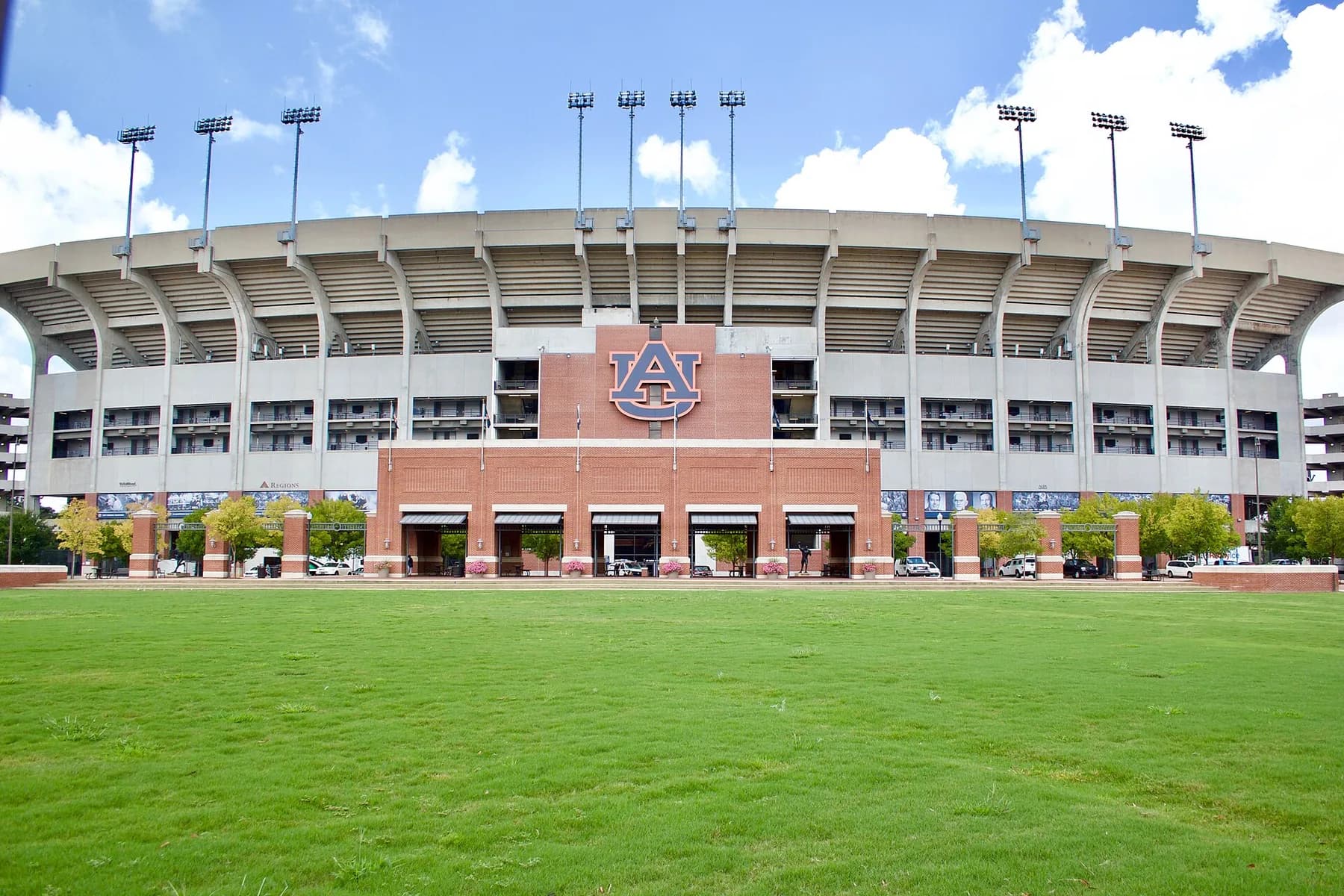
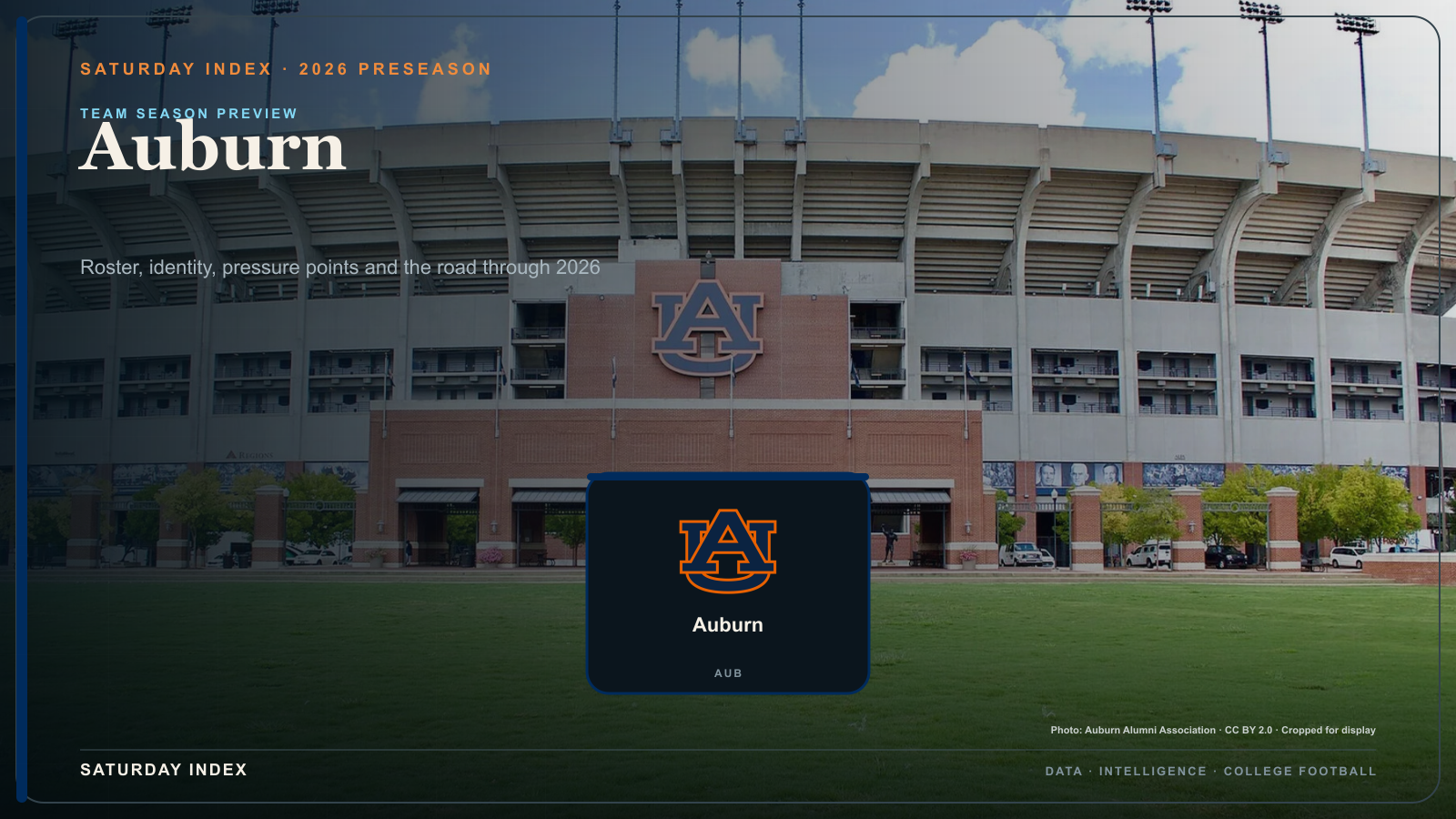
Photo: Auburn Alumni Association · CC BY 2.0 · Cropped for display
Up next · Week 9
Away
On the road at
Saturday, October 31 · Time TBA
The season, taking shape
Final scores show Auburn first. Oldest to newest.
vs. VanderbiltPregame 29–28
Game details at Tennessee
Pregame 24–31
Game details at Georgia
Pregame 16–36
Game detailsOriginal full-season forecast
This forecast retains the original probabilities for the full schedule. It does not update with completed results or this week’s forecast.
2026 results
Current record, team efficiency, player production, and verified results from completed games.
Current record
4-34 wins · 3 lossesThrough 7 completed gamesLoading player usage…
2026 season preview
Auburn’s 2026 season hinges on whether familiarity can impose order on sweeping change. First-year head coach Alex Golesh and offensive coordinators Kodi Burns and Joel Gordon are installing a new system around a heavily reshaped roster, while returning defensive coordinator D.J. Durkin provides continuity on the other side of the ball. Byrum Brown and several former USF teammates already understand Golesh’s offense. The question is whether that head start can help Auburn settle its rebuilt lines and secondary before the schedule applies real pressure.
THE STANDARD — Golesh has not attached a public win target to his first season. At SEC Media Days, he instead described the goal as building a physically and mentally tough, detailed, connected and player-led team. That standard matters for a program projected by SEC media to finish 12th in the 16-team league. Auburn needs its new identity to become visible in down-to-down execution and competitive consistency, especially when an unsettled roster reaches the difficult portions of conference play.
Original season forecast
The original SEC forecast, retained alongside current results.
SEC projected standing
#12
4-5 projected · 3.6 expected conference wins · #12 of 16.
Preseason baseline
2025 percentiles retained as preseason context; current results and player production lead this page.
2025 FBS percentile scale · 50 is average
Incoming class
National and conference recruiting ranks, confirmed commitments, and the highest-ranked recruits in this class.
Top committed recruits
Auburn2026 transfer movement
Incoming and outgoing transfer activity, with rated FBS-to-FBS moves below.
Incoming Transfers
AuburnOutgoing Transfers
AuburnSeason schedule
Completed games show final results. Upcoming games use this week’s forecast where available; later games retain their published season outlook.
Detailed football intelligence
The full team identity, offense, defense, and supporting evidence.
Team identity
Last season, Auburn tried to stay balanced between the run and pass; the results were uneven when the offense tried to live that way.
Why it matters
The run game was Auburn's steadier way to stay ahead of the chains; opponents have to win early fits without handing away play action.
 vs. LSU
Pregame 22–30
Game detailsPregame comparisons use preserved published forecasts. Results include wins and losses.
At a glance
Current form leads the outlook.
2026 rates aggregate verified completed-game box scores. EPA is expected points added per play.
| Player | C/ATT | YDS | TD | INT |
|---|---|---|---|---|
| Byrum Brown | 133/208 | 1362 | 8 | 7 |
| Tristan Ti'a | 7/11 | 83 | 0 | 0 |
| Christian Neptune | 2/2 | 29 | 2 | 0 |
| Player | CAR | YDS | AVG | TD |
|---|---|---|---|---|
| Byrum Brown | 126 | 480 | 3.8 | 6 |
| Jeremiah Cobb | 62 | 320 | 5.2 | 2 |
| Omar Mabson Ii | 41 | 240 | 5.9 | 1 |
| Player | REC | YDS | AVG | TD |
|---|---|---|---|---|
| Keshaun Singleton | 36 | 431 | 12.0 | 2 |
| Chas Nimrod | 33 | 340 | 10.3 | 3 |
| Jeremiah Koger | 14 | 230 | 16.4 | 0 |
| Player | TOT | SOLO | TFL | SACK |
|---|---|---|---|---|
| Elijah Melendez | 57 | 38 | 9 | 4 |
| Eric Winters | 41 | 33 | 2 | 0 |
| Kaleb Harris | 41 | 29 | 0 | 0 |
Saturday, October 24 · Jordan-Hare Stadium
Saturday, October 17 · Sanford Stadium
Saturday, October 3 · Neyland Stadium
THE QUARTERBACK — Brown is the offense’s most important source of familiarity. He said his spring work focused on improving his progressions and checkdowns, and he described himself and former USF teammates as teachers of the scheme. That leadership can shorten the installation process, but its greater value should appear after the snap. Against SEC defenses, Brown’s ability to move through reads and take efficient outlets will help determine whether Auburn can stay on schedule while the protection comes together.
THE SKILL GROUP — Golesh also brought proven production from USF. Jeremiah Koger caught 38 passes for 597 yards and eight touchdowns in 2025, Christian Neptune added 38 catches for 335 yards, and Nykahi Davenport rushed for 612 yards at 6.2 yards per carry. Their timing with Brown gives the offense a foundation while other roles develop. Freshman receiver DeShawn Spencer made his case at A-Day, catching nine passes for 93 yards and earning offensive MVP honors, but Auburn has not established the complete receiver and tight-end rotations.
THE HINGE — Auburn officially listed 39 portal additions, including nine offensive linemen, but adding options is different from forming a dependable five-man unit. A late-July report described the line as the team’s largest spring concern, even as Golesh said he felt good about the room entering camp. Its protection and run-game cohesion will decide how much of the offense’s existing familiarity carries into SEC play. In the backfield, Justin Ferguson identified returning starter Jeremiah Cobb as the expected leader; Bryson Washington was working toward full speed, while Omar Mabson II had drawn praise for pass protection.
THE DEFENSE — Durkin’s continuity gives Auburn a chance to establish its defensive identity more quickly. At A-Day, the defense held the offense to 2-for-15 on third down and was credited with five takeaways, seven sacks and nine tackles for loss. Edge Jared Smith returned an interception for a touchdown and recovered a fumble. Those numbers are an encouraging measure of disruption, though one spring scrimmage cannot separate defensive progress from the offense’s unresolved protection and ball-security problems.
THE CENTERPIECES — Linebacker Xavier Atkins entered the spring after leading Auburn in 2025 with 84 tackles, 17 tackles for loss and nine sacks, then earned preseason first-team All-SEC recognition. His production gives Durkin a proven centerpiece while the front sorts out its interior run defense and complementary pressure. Veteran defensive back Champ Anthony had been fully cleared by SEC Media Days after leg injuries cost him parts of the previous two seasons. His experience matters in a secondary supplemented by seven portal additions, although its corner and safety combinations remain unsettled.
SPECIAL TEAMS — Alex McPherson gives Auburn another established strength. He entered 2026 having made 40 of 45 career field-goal attempts, an Auburn-record 88.9 percent, and earned A-Day special-teams MVP after converting from 26 and 55 yards. A kicker with that record and range can preserve points when a developing offense stalls. Auburn still must settle its punting and return roles, but McPherson’s past production offers meaningful stability in games that may leave little margin for wasted possessions.
THE PRESSURE POINTS — Auburn opens against Baylor in Atlanta, then hosts Florida and Vanderbilt before traveling to Tennessee. The later road schedule includes Georgia, Ole Miss and Alabama. That arrangement offers little patience for a rebuilt offensive line or a secondary learning to play together: Auburn needs functional combinations early, then must sustain them through a road-heavy set of conference tests and rivalry games.
Golesh’s first Auburn team has recognizable anchors in Brown, Atkins, Anthony and McPherson, plus a group of former USF players capable of teaching the new offense from within. It also has consequential questions at offensive line, in the backfield rotation and across the secondary. The season’s defining issue is how quickly those pieces become connected enough to meet Golesh’s standard. Familiarity gives Auburn a starting point; cohesion will determine whether the rebuild can withstand the schedule.
This preview is based on the linked public reporting and official program records.
Profile high point
The run game held the profile's highest percentile position.Profile low point
Big-play creation held the lowest percentile position among the profile's strength measures.

The run game is what Auburn can trust most.
Why it matters
The offense has its best route to favorable third downs and a credible play-action menu; explosive-play creation remains the first counter an opponent should test.
Big-play creation is Auburn's biggest concern, and opponents can test it immediately.
Why it matters
Opponents can squeeze underneath space and make the offense finish long drives without chunk gains; rushing structure has to keep that stress from setting the game plan.
Auburn is at its best when it can stay balanced between the run and pass, then let the run game finish drives; an average pace puts more weight on winning ordinary downs.
What matters
Auburn's balanced structure played at a balanced pace. The run game finished top-tier, while the pass game finished weak.
Inside the team
Open a section for the football detail and supporting numbers.
The down-to-down question that determines whether the offense can keep both the run and pass available.
Opponents have to keep Auburn's run game from turning first down into second-and-manageable.
Why it matters
If Auburn stays on schedule on the ground, the offense keeps more answers available.
The pace, play selection, and methods this offense uses to stay on schedule.
Auburn played at a balanced pace in 2025.
Why it matters
At that pace, Auburn cannot count on extra possessions or expect to shorten the game.
Auburn's prior passing record was weak.
Why it matters
Auburn's offense needs protection, field position, or explosive variance when ordinary dropbacks do not create enough value.
Auburn's prior rushing record was top-tier.
Why it matters
A sustainable run game keeps Auburn's play action credible and limits obvious passing situations.
Explosive plays were a two-way concern in Auburn's record last season.
Why it matters
That combination increases dependence on sustained drives while leaving little margin for a missed fit or coverage error.
How consistently the offense creates manageable situations and the defense prevents them.
Auburn's defense was more consistent down to down than its offense.
Why it matters
Auburn's success rate shows whether it can sustain drives and get stops without relying on sacks, turnovers, or isolated big plays.
Opponent-adjusted EPA identifies the run game as Auburn's stronger offensive unit.
Why it matters
Forcing longer passing situations is the clearest way to move the offense away from its stronger adjusted unit.
Where the defense can create pressure, control the run, and end drives.
Auburn's prior defense was strong overall and strongest in run front.
Why it matters
Opponents can use efficient throws to stay out of obvious passing downs; Auburn needs its run front to create long-yardage without overloading the box before that plan settles in.
Auburn's available disruption measures ranked in a strong national range last season; a charted pressure rate is not available.
Why it matters
Sustained disruption can create negative plays and give Auburn a better chance to end drives before third down.
Auburn's disruption regularly finished at the quarterback.
What matters
Both sack production and front-seven disruption cleared the FBS midpoint.
Auburn's prior run-defense results were top-tier.
Why it matters
A dependable run front can let Auburn create obvious passing downs without committing extra bodies to the box.