Week 4 · FinalW
 vs. Tulsa
34–6+28 margin
Pregame 36–17
Game detailsSaturday Index
Loading team intelligenceBringing the latest verified football information into focus.
SEC · 2026 · Week 8
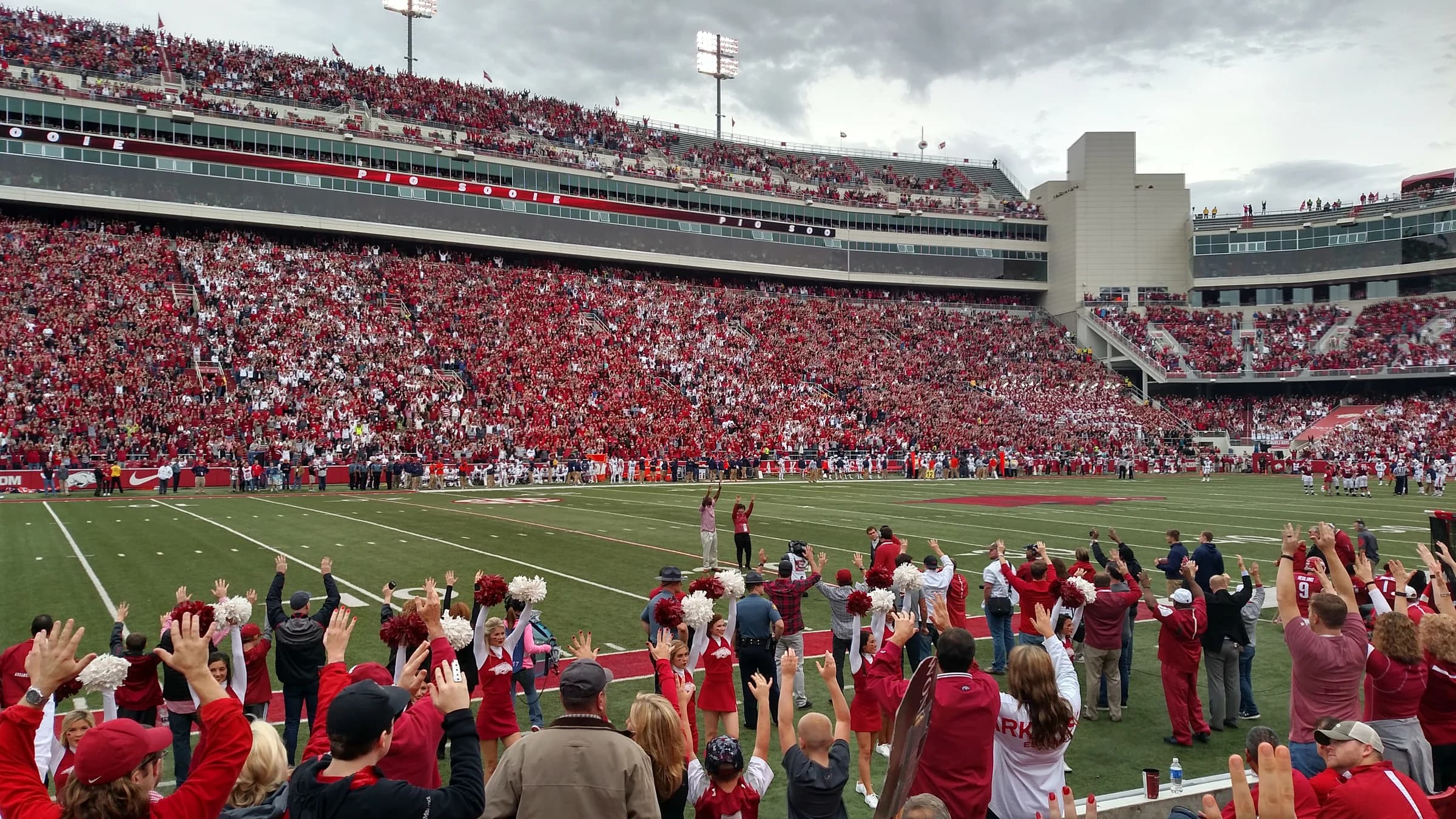
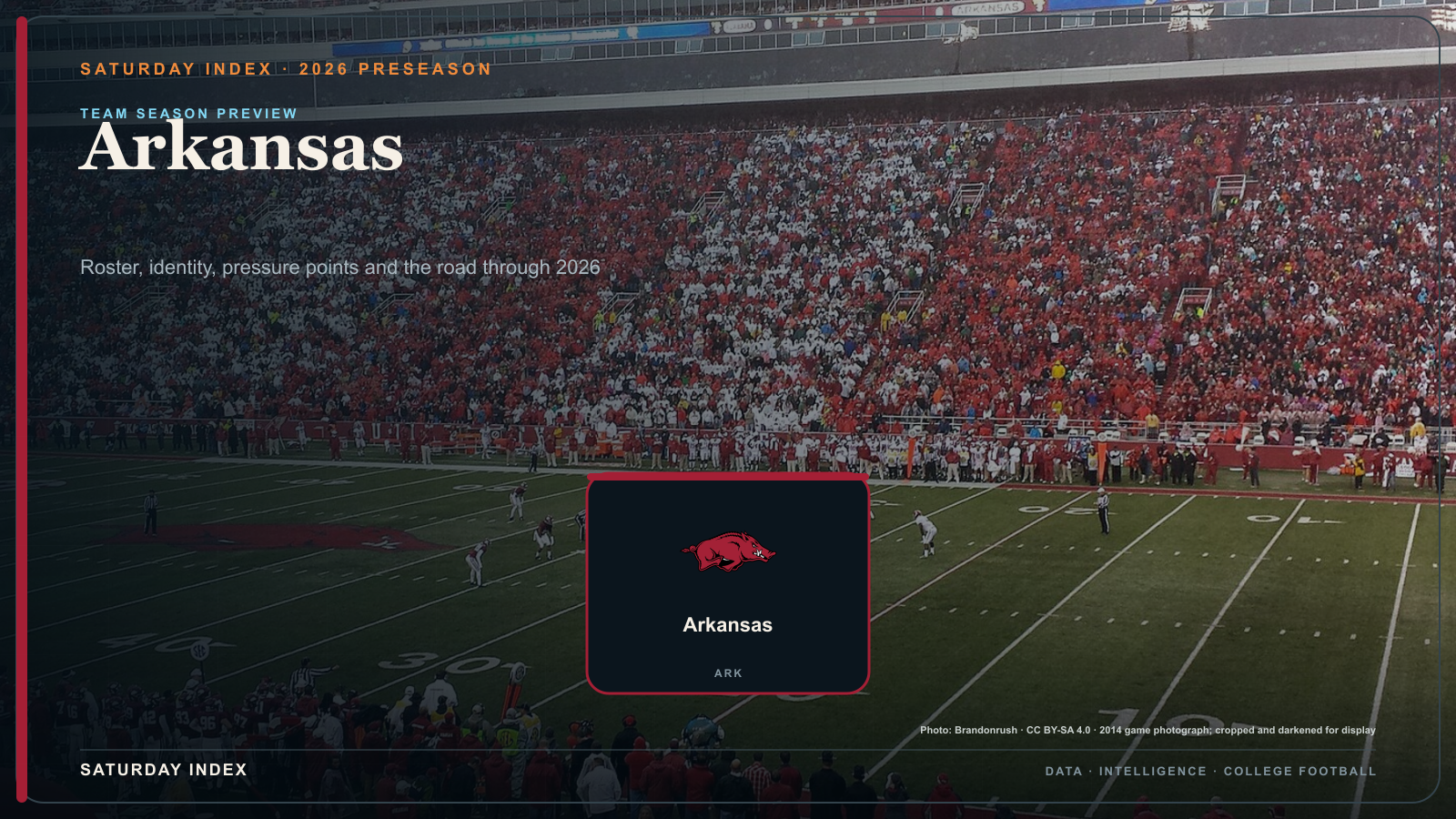
Photo: Brandonrush · CC BY-SA 4.0 · Archive venue photograph, 2015 · Cropped for display
Up next · Week 9
Home
Hosting
Saturday, October 31 · Time TBA
The season, taking shape
Final scores show Arkansas first. Oldest to newest.
vs. TulsaPregame 36–17
Game details at Texas A&M
Pregame 19–35
Game details vs. Tennessee
Pregame 20–32
Game detailsOriginal full-season forecast
This forecast retains the original probabilities for the full schedule. It does not update with completed results or this week’s forecast.
2026 results
Current record, team efficiency, player production, and verified results from completed games.
Current record
3-43 wins · 4 lossesThrough 7 completed gamesLoading player usage…
2026 season preview
Ryan Silverfield’s first Arkansas team does not lack possibilities. The question is how quickly those possibilities can become a dependable football team. Tim Cramsey is installing the offense, Ron Roberts is leading the defense and Chad Lunsford is overseeing special teams, while transfers are being incorporated across every major position group. Several Memphis additions already know Silverfield or Cramsey, but familiarity in one corner of the roster cannot substitute for cohesion across all three phases.
The quarterback competition will shape everything Cramsey wants to build. During spring practice, he identified KJ Jackson and Memphis transfer AJ Hill as quarterbacks around whom he believed he could construct winning game plans, without naming a starter. Both are lightly proven at the SEC level, and Arkansas is replacing veteran offensive production. The eventual choice must do more than distribute the ball: he will have to steady an offense whose protection and pass-catching order are also taking form.
Original season forecast
The original SEC forecast, retained alongside current results.
SEC projected standing
#14
2-7 projected · 1.9 expected conference wins · #14 of 16.
Preseason baseline
2025 percentiles retained as preseason context; current results and player production lead this page.
2025 FBS percentile scale · 50 is average
Incoming class
National and conference recruiting ranks, confirmed commitments, and the highest-ranked recruits in this class.
Top committed recruits
Arkansas2026 transfer movement
Incoming and outgoing transfer activity, with rated FBS-to-FBS moves below.
Incoming Transfers
ArkansasOutgoing Transfers
ArkansasSeason schedule
Completed games show final results. Upcoming games use this week’s forecast where available; later games retain their published season outlook.
Detailed football intelligence
The full team identity, offense, defense, and supporting evidence.
Team identity
Last season, Arkansas tried to stay balanced between the run and pass; the approach consistently kept the offense on schedule.
Why it matters
The run game was Arkansas's steadier way to stay ahead of the chains; opponents have to win early fits without handing away play action.
 at Vanderbilt
Pregame 22–30
Game detailsPregame comparisons use preserved published forecasts. Results include wins and losses.
At a glance
Current form leads the outlook.
2026 rates aggregate verified completed-game box scores. EPA is expected points added per play.
| Player | C/ATT | YDS | TD | INT |
|---|---|---|---|---|
| KJ Jackson | 130/213 | 1442 | 6 | 4 |
| AJ Hill | 16/28 | 181 | 1 | 0 |
| Player | CAR | YDS | AVG | TD |
|---|---|---|---|---|
| Braylen Russell | 58 | 205 | 3.5 | 2 |
| Sutton Smith | 54 | 194 | 3.6 | 1 |
| Cam Settles | 43 | 176 | 4.1 | 2 |
| Player | REC | YDS | AVG | TD |
|---|---|---|---|---|
| Chris Marshall | 44 | 641 | 14.6 | 2 |
| Ty Lockwood | 14 | 127 | 9.1 | 0 |
| Jamari Hawkins | 8 | 126 | 15.8 | 0 |
| Player | TOT | SOLO | TFL | SACK |
|---|---|---|---|---|
| Ja'Quavion Smith | 50 | 20 | 3 | 1 |
| Ben Bogle | 47 | 20 | 2.5 | 1 |
| Khmori House | 41 | 22 | 5 | 2 |
Saturday, October 17 · FirstBank Stadium
Saturday, October 10 · Razorback Stadium
Saturday, October 3 · Kyle Field
The backfield offers the clearest way to ease that burden. Braylen Russell, Sutton Smith, Jasper Parker and Cam Settles formed the spring working group, and Cramsey emphasized using the backs in space and in the passing game. That versatility can create manageable throws, punish unfavorable matchups and let Arkansas change personnel without changing its basic intentions. Smith’s selection to join Silverfield at SEC Media Days also points to a leadership role in a room positioned to give the offense its most reliable foundation.
Up front, Arkansas has options rather than a finished answer. Cramsey estimated in April that eight or nine offensive linemen were usable, with returnees Kobe Branham and Caden Kitler joined by experienced transfers Bryant Williams, Adam Hawkes, Malachi Breland and Kavion Broussard. Kitler gives the group a visible veteran reference point, but the larger task is turning that competition into five players who communicate and move as one. The receiving hierarchy also must emerge, making protection and backfield versatility especially important while the passing game defines its preferred targets.
Roberts is constructing the defense around multiplicity, with the ability to use odd and four-down fronts. He has emphasized technical soundness and pursuit to the ball, priorities that matter more than schematic variety for a unit drawing players from many systems. The flexibility could help Arkansas tailor roles to its personnel and alter presentations from week to week. It will work only if the defense communicates cleanly enough to avoid turning disguise into confusion.
Quincy Rhodes Jr. is the player who can make that structure dangerous. He produced 44 tackles, 15.5 tackles for loss and eight sacks in 2025, then received second-team preseason All-SEC recognition from media. He is the established front-line disruptor opponents must locate before every snap. Hunter Osborne, Trajen Odom, Carlon Jones and Steven Soles are among the players who could supply complementary pressure; Soles had two sacks in the spring game, though the group still must translate its promise into sustained work against SEC blocking.
Bradley Shaw provides another point of continuity after totaling 62 tackles and 7.5 tackles for loss across his first two Arkansas seasons. Transfers Phoenix Jackson, Jeremy Evans and Ben Bogle give Roberts veteran choices around him, with open-field tackling and coverage likely to determine which combinations last. The secondary presents a similar fit challenge. Joker Johnson, La’Khi Roland, Christian Harrison and Khmori House arrived through the transfer market, and Roberts has described Harrison as a starting-caliber communicator who can play multiple positions. His versatility is valuable, but collective communication will matter more than any single player’s range.
Arkansas’ SEC Media Days delegation offered a useful picture of the roster’s emerging leadership. Kitler represented the offensive line, Smith the backfield and Rhodes the defensive front. That group cannot settle every competition, but it gives Silverfield established voices in three rooms central to the transition. How effectively those players connect a new staff to a changing roster may be as consequential as their individual production.
The schedule will reveal the pace of the rebuild almost immediately. Arkansas opens at home against North Alabama, then travels to Utah for a 9:15 p.m. ET kickoff before hosting Georgia in the SEC opener one week later. One lower-division tune-up precedes a late finish at altitude and a major conference test. For an offense choosing a quarterback and an entire team learning new systems, September leaves little room for a slow installation.
The pressure returns late. After an October 24 open date, Arkansas closes with Missouri, at Auburn, South Carolina, at Texas and LSU. That run combines SEC home games, road demands and rivalry stakes at a point when depth and durability usually matter most. Fall camp still must clarify the quarterback, offensive-line and receiving orders, along with specialist jobs, freshman roles and complete Week 1 availability. No responsible record prediction follows yet. The more useful measure is whether Silverfield can turn backfield versatility, Rhodes’ disruption and a wide pool of newcomers into a team stable enough to meet both of the schedule’s pressure points.
This preview is based on the linked public reporting and official program records.
Profile high point
The run game held the profile's highest percentile position.Profile low point
Down-to-down defense held the lowest percentile position among the profile's strength measures.


The run game is what Arkansas can trust most.
Why it matters
The offense has its best route to favorable third downs and a credible play-action menu; defensive control remains the first counter an opponent should test.
The defense's control of ordinary downs is Arkansas's biggest concern, and opponents can test it immediately.
What matters
Arkansas's defensive control ranked near the bottom nationally last season.
Arkansas's best path is to stay balanced between the run and pass, then let the run game finish drives; fewer possessions make every empty drive more expensive.
Why it matters
Arkansas's clean script is to stay ahead with early-down runs, draw an extra defender into the box, and then use play action; defenses will try to force obvious passing downs. In a slower game, one empty drive or failed early-down series carries extra weight.
Inside the team
Open a section for the football detail and supporting numbers.
The down-to-down question that determines whether the offense can keep both the run and pass available.
Opponents have to keep Arkansas's run game from turning first down into second-and-manageable.
Why it matters
If Arkansas stays on schedule on the ground, the offense keeps more answers available.
The pace, play selection, and methods this offense uses to stay on schedule.
Arkansas played at a deliberate pace in 2025.
What matters
Arkansas worked with fewer possessions than most teams last season.
Arkansas's prior passing record was strong.
Why it matters
A repeatable pass game can let Arkansas punish loaded boxes without relying on low-frequency deep completions.
Arkansas's prior rushing record was top-tier.
Why it matters
A sustainable run game keeps Arkansas's play action credible and limits obvious passing situations.
Arkansas's explosive-play upside came with real defensive volatility.
Why it matters
That mix can produce fast scoring swings in either direction and makes missed tackles or coverage busts especially expensive.
How consistently the offense creates manageable situations and the defense prevents them.
Arkansas's offense was more consistent down to down than its defense.
Why it matters
Arkansas's success rate shows whether it can sustain drives and get stops without relying on sacks, turnovers, or isolated big plays.
Opponent-adjusted EPA identifies the run game as Arkansas's stronger offensive unit.
Why it matters
Forcing longer passing situations is the clearest way to move the offense away from its stronger adjusted unit.
Where the defense can create pressure, control the run, and end drives.
Arkansas's prior defense was bottom-tier overall and strongest in disruption.
Why it matters
Opponents can use efficient throws to stay out of obvious passing downs; Arkansas needs its disruption to change protection and erase drives with negative plays before that plan settles in.
Arkansas's available disruption measures finished below the national average last season; a charted pressure rate is not available.
Why it matters
Without consistent disruption, Arkansas's defense must win more snaps through coverage, leverage, and early-down prevention.
Arkansas's sack and disruption results were below-average.
Why it matters
Arkansas's disruption can hurry an offense; sacks do more by erasing field position and ending passing downs.
Arkansas's prior run-defense results were bottom-tier.
Why it matters
If Arkansas's front cannot control early downs, opponents can keep every offensive option open and protect their passing game.