Week 5 · FinalL
 vs. Baylor
19–55-36 margin
Pregame 26–24
Game detailsSaturday Index
Loading team intelligenceBringing the latest verified football information into focus.
Big 12 · 2026 · Week 8

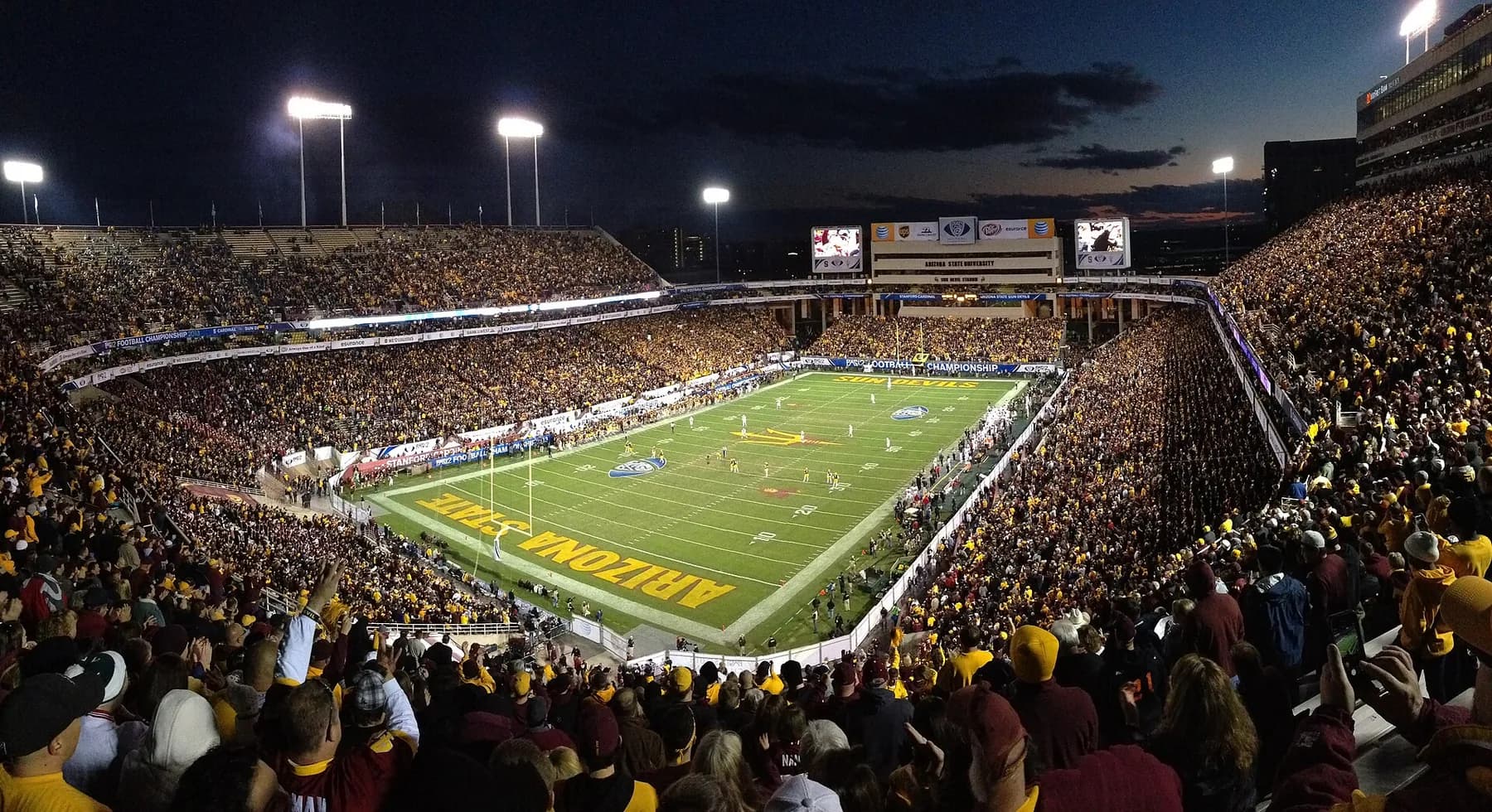
Photo: Clintus McGintus · CC BY-SA 2.0 · Cropped for display
Up next · Week 9
Away
On the road at
Saturday, October 31 · Time TBA
The season, taking shape
Final scores show Arizona State first. Oldest to newest.
vs. BaylorPregame 26–24
Game details vs. Hawai'i
Pregame 33–19
Game details at Texas Tech
Pregame 15–36
Original full-season forecast
This forecast retains the original probabilities for the full schedule. It does not update with completed results or this week’s forecast.
2026 results
Current record, team efficiency, player production, and verified results from completed games.
Current record
4-34 wins · 3 lossesThrough 7 completed gamesLoading player usage…
2026 season preview
Arizona State enters 2026 with recognizable top-end talent and a roster transformed enough that cohesion matters more than name recognition. Confirmed departures include quarterback Sam Leavitt and running back Raleek Brown, while additions at quarterback, receiver, edge and defensive back reshape the team. The central question is whether Kenny Dillingham can turn those pieces into a dependable group before a schedule that moves quickly from a home opener against Morgan State to trips against Texas A&M and Kansas.
Dillingham retains offensive coordinator Marcus Arroyo and defensive coordinator Brian Ward, with Hines Ward serving as associate head coach and receivers coach. Jack Nudo's promotion at special teams is the principal coordinator-level change. That continuity should preserve the broad structure on offense and defense, but it cannot manufacture timing for a remade offensive line or settle an open quarterback race. For this team, familiar direction from the sideline matters only if it accelerates trust among unfamiliar combinations.
Original season forecast
The original Big 12 forecast, retained alongside current results.
Big 12 projected standing
#7
5-4 projected · 4.5 expected conference wins · #7 of 16.
Preseason baseline
2025 percentiles retained as preseason context; current results and player production lead this page.
2025 FBS percentile scale · 50 is average
Incoming class
National and conference recruiting ranks, confirmed commitments, and the highest-ranked recruits in this class.
Top committed recruits
Arizona State2026 transfer movement
Incoming and outgoing transfer activity, with rated FBS-to-FBS moves below.
Incoming Transfers
Arizona StateOutgoing Transfers
Arizona StateSeason schedule
Completed games show final results. Upcoming games use this week’s forecast where available; later games retain their published season outlook.
Detailed football intelligence
The full team identity, offense, defense, and supporting evidence.
Team identity
Last season, Arizona State tried to lean on the running game; too many drives still went off schedule.
Why it matters
Neither offensive unit clearly carried the other, so first-down execution decides whether Arizona State can stay on plan.
 vs. Kansas State
Pregame 25–30
Game detailsPregame comparisons use preserved published forecasts. Results include wins and losses.
At a glance
Current form leads the outlook.
2026 rates aggregate verified completed-game box scores. EPA is expected points added per play.
| Player | C/ATT | YDS | TD | INT |
|---|---|---|---|---|
| Cutter Boley | 104/168 | 1353 | 13 | 5 |
| Mikey Keene | 29/41 | 288 | 2 | 0 |
| Jake Fette | 1/2 | 13 | 0 | 0 |
| Player | CAR | YDS | AVG | TD |
|---|---|---|---|---|
| Kyson Brown | 60 | 329 | 5.5 | 1 |
| Cardae Mack | 29 | 241 | 8.3 | 2 |
| Marquis Gillis | 28 | 133 | 4.8 | 1 |
| Player | REC | YDS | AVG | TD |
|---|---|---|---|---|
| Reed Harris | 41 | 653 | 15.9 | 8 |
| Omarion Miller | 35 | 370 | 10.6 | 2 |
| Grayson Rigdon | 2 | 110 | 55.0 | 2 |
| Player | TOT | SOLO | TFL | SACK |
|---|---|---|---|---|
| Owen Long | 52 | 28 | 1 | 0 |
| Martell Hughes | 40 | 21 | 5.5 | 0 |
| Jessiah Mcgrew | 31 | 22 | 0 | 0 |
Saturday, October 24 · Mountain America Stadium
Saturday, October 17 · Jones AT&T Stadium
Saturday, October 10 · Mountain America Stadium
Arizona State left spring without naming a starter among Kentucky transfer Cutter Boley, veteran Mikey Keene, returner Cameron Dyer and freshman Jake Fette. Boley took most of the work with the projected starters, giving him a spring lead rather than the job. He completed 65.8 percent of his passes with 15 touchdowns as a Kentucky freshman, but his 12 interceptions sharpen the ball-security question. Keene counters with more than 1,000 college reps and nearly 3,000 passing yards in both 2023 and 2024 at Fresno State. Boley offers developmental upside; Keene offers veteran command. The fall order remains unclear, and the winner's ability to avoid wasted possessions may matter more than stylistic differences.
There is help outside. Omarion Miller, who produced 808 receiving yards and eight touchdowns at Colorado in 2025, and 6-foot-5 Reed Harris developed spring rapport with Boley. Miller's preseason All-Big 12 selection gives the eventual starter a recognized perimeter threat. Kyson Brown entered the preseason as the likely lead runner after an ankle injury limited him in 2025, with Jason Brown Jr., Demarius Robinson, Marquis Gillis and David Avit behind him. Their value depends on the rebuilt line: all five players who started the 2025 opener are gone, making protection and run-game cohesion the offense's largest structural concern.
The first spring line featured Jalen Klemm, Maki Stewart, Georgia Tech transfer Tana Alo-Tupuola, Ui Muti and Siosaia Lapuaho from left to right. That was an early combination, not a settled fall unit. Arroyo needs five blockers who can communicate cleanly enough to keep the quarterback choice from becoming a weekly survival exercise and create a reliable role for the lead back. Miller and Harris can stress defenses outside, but their presence will carry less force if Arizona State cannot stay on schedule up front.
Brian Ward's defense has a clear starting point in C.J. Fite, a preseason All-Big 12 selection on the interior. Edge transfers Jalen Thompson and Emar'rion Winston join Albert Smith III in a revamped front that must create pressure without constantly borrowing help from the back end. The linebackers offer the most stability: Colorado State transfer Owen Long joins returners Martell Hughes and Zyrus Fiaseu, with freshmen Isaiah Iosefa and Mason Marden developing behind them. That experienced second level can steady the defense while new combinations settle around it.
The secondary has options but still needs role clarity. Transfers Ashton Stamps, Caleb Chester and Antoine Belgrave-Shorter join a group expected to feature returning corner Rodney Bimage Jr. Adrian Wilson explored nickel after a shoulder injury cost him most of spring, leaving his availability and the final corner, nickel and safety combinations unsettled. Special teams carries similar change: Austin Peay transfer Carson Smith made 14 of 17 field goals in 2025, including a 50-yarder, while Ohio State transfer Nick McLarty arrives lightly tested in games. Smith's prior work with Nudo offers familiarity, but final kicking, punting and return roles remain unclear.
The calendar gives the rebuild little room to idle. After Morgan State, Arizona State goes to Texas A&M and then meets Kansas at Wembley Stadium before an open date and Baylor. Later, the Sun Devils visit Texas Tech, host Kansas State and travel to BYU on consecutive weekends. The closing stretch includes trips to UCF and Arizona around a home game with Oklahoma State. Those sequences put a premium on depth and communication rather than supporting any clean prediction. Arizona State's ceiling rests on Miller and Fite playing like proven difference-makers; its floor will be shaped by quarterback ball security, offensive-line growth and how quickly the secondary finds dependable roles. Final roles and availability remain unsettled.
This preview is based on the linked public reporting and official program records.
Profile high point
Pressure held the profile's highest percentile position.Profile low point
Passing held the lowest percentile position among the profile's strength measures.




Front-seven disruption is what Arizona State can trust most.
Why it matters
The defense has its best route to changing protection rules before coverage must hold; offensive efficiency remains the first counter an opponent should test.
The first place to test Arizona State is the offense's down-to-down consistency, especially on ordinary early downs; front-seven disruption has to keep the game on plan.
What matters
Arizona State's offensive efficiency ranked in the lower national range last season.
Arizona State is at its best when it can lean on the running game, then keep winning first down because neither the pass nor run can rescue the other; extra possessions give that plan time to build.
What matters
Arizona State's run-leaning structure played at a fast pace. Passing finished below-average and rushing finished below-average, without a clear split between them.
Inside the team
Open a section for the football detail and supporting numbers.
The down-to-down question that determines whether the offense can keep both the run and pass available.
Arizona State must establish a first-down answer before opponents have to defend both the run and pass.
Why it matters
Without one part of the offense forcing an adjustment, opponents can keep the offense in long-yardage and play from a position of strength.
The pace, play selection, and methods this offense uses to stay on schedule.
Arizona State played at a fast pace in 2025.
Why it matters
More possessions give Arizona State's strengths additional chances to build, but they also leave more time to recover from mistakes.
Arizona State's prior passing record was below-average.
Why it matters
Arizona State's offense needs protection, field position, or explosive variance when ordinary dropbacks do not create enough value.
Why it matters
When Arizona State's run game cannot stay on schedule, protection and passing-down execution carry more of the offense.
Arizona State's explosive-play results were mixed rather than a defining edge.
Why it matters
A big play can still flip a possession, but last season's results do not make explosiveness something this team can rely on.
How consistently the offense creates manageable situations and the defense prevents them.
Arizona State's defense was more consistent down to down than its offense.
Why it matters
Arizona State's success rate shows whether it can sustain drives and get stops without relying on sacks, turnovers, or isolated big plays.
Arizona State's opponent-adjusted passing and rushing value were closely matched.
Why it matters
When the split is narrow, early-down execution matters more than steering the offense toward one obvious weakness.
Where the defense can create pressure, control the run, and end drives.
Arizona State's prior defense was strong overall, with no clear separation among its main units.
Why it matters
That balance makes it harder for an offense to choose one automatic target; the defense still has to win early downs before any unit can dictate the offensive options.
Arizona State's available disruption measures ranked in a strong national range last season; a charted pressure rate is not available.
Why it matters
Sustained disruption can create negative plays and give Arizona State a better chance to end drives before third down.
Arizona State's disruption regularly finished at the quarterback.
What matters
Both sack production and front-seven disruption cleared the FBS midpoint.
Arizona State's prior run-defense results were strong.
Why it matters
A dependable run front can let Arizona State create obvious passing downs without committing extra bodies to the box.