
Week 4 · FinalW
 at Washington State
34–24+10 margin
Pregame 31–20
Game detailsSaturday Index
Loading team intelligenceBringing the latest verified football information into focus.
Big 12 · 2026 · Week 8

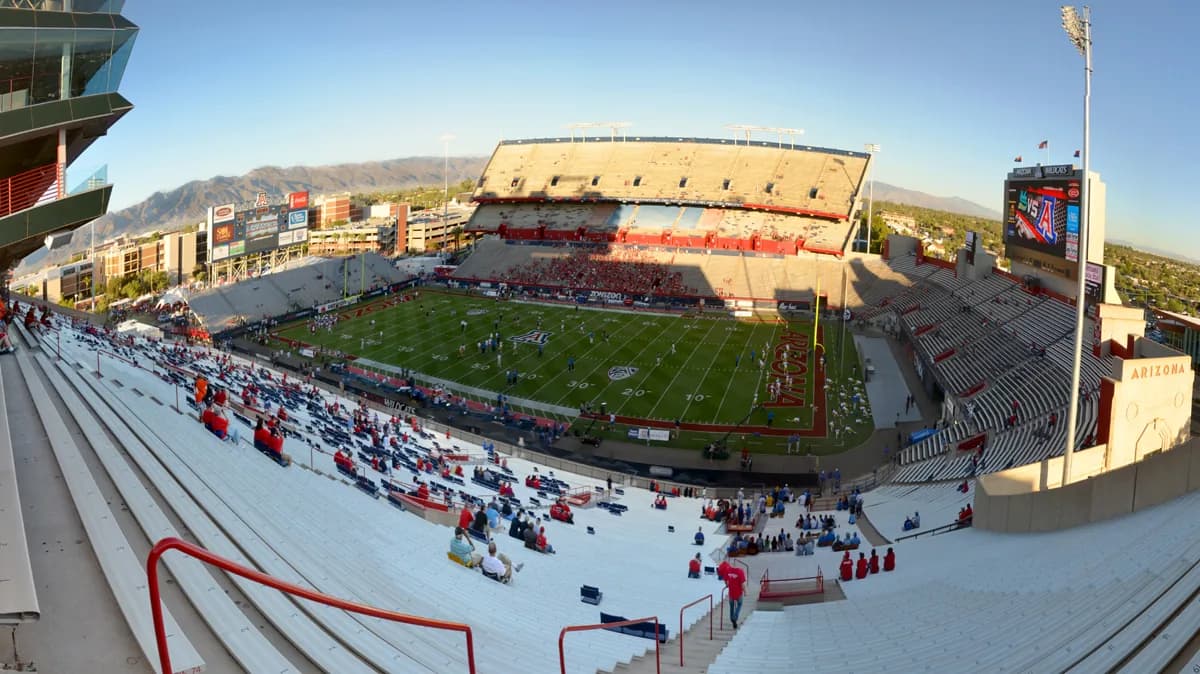
Photo: Wcarlisle4 · CC BY-SA 3.0 · Cropped for display
Up next · Week 9
Away
On the road at
Saturday, October 31 · Time TBA
The season, taking shape
Final scores show Arizona first. Oldest to newest.
at Washington StatePregame 31–20
Game details vs. Cincinnati
Pregame 33–22
Game details at West Virginia
Pregame 34–23
Original full-season forecast
This forecast retains the original probabilities for the full schedule. It does not update with completed results or this week’s forecast.
2026 results
Current record, team efficiency, player production, and verified results from completed games.
Current record
6-16 wins · 1 lossThrough 7 completed gamesLoading player usage…
2026 season preview
Arizona enters Brent Brennan’s third season with a rare advantage in modern college football: its head coach, coordinators and decorated quarterback all return from a nine-win team. That continuity gives the Wildcats a clear path, but not an easy one. Noah Fifita can make Arizona dangerous again only if a reshaped offensive line protects him, new receiving roles emerge and an overhauled secondary becomes coherent before the schedule tightens. Arizona’s season is less about discovering an identity than preserving the one that powered its 2025 rebound.
Brennan, extended through 2030, kept offensive coordinator Seth Doege and defensive coordinator Danny Gonzales, both extended through 2028. The value is practical as much as symbolic. Under Doege, Arizona’s scoring rose from 21.8 points per game in 2024 to 31.5 in 2025, third in the Big 12. Rather than installing another system, the Wildcats can spend camp refining one in which Fifita already made a dramatic efficiency jump. Brennan’s central task is to make continuity at the top outweigh turnover in two critical units.
Original season forecast
The original Big 12 forecast, retained alongside current results.
Big 12 projected standing
#5
5-4 projected · 5.4 expected conference wins · #5 of 16.
Preseason baseline
2025 percentiles retained as preseason context; current results and player production lead this page.
2025 FBS percentile scale · 50 is average
Incoming class
National and conference recruiting ranks, confirmed commitments, and the highest-ranked recruits in this class.
Top committed recruits
Arizona2026 transfer movement
Incoming and outgoing transfer activity, with rated FBS-to-FBS moves below.
Incoming Transfers
ArizonaOutgoing Transfers
ArizonaSeason schedule
Completed games show final results. Upcoming games use this week’s forecast where available; later games retain their published season outlook.
Detailed football intelligence
The full team identity, offense, defense, and supporting evidence.
Team identity
Last season, Arizona tried to lean on the passing game; the approach gave the offense a dependable starting point.
Why it matters
Neither offensive unit clearly carried the other, so first-down execution decides whether Arizona can stay on plan.
 vs. Iowa State
Pregame 32–20
Game detailsPregame comparisons use preserved published forecasts. Results include wins and losses.
At a glance
Current form leads the outlook.
2026 rates aggregate verified completed-game box scores. EPA is expected points added per play.
| Player | C/ATT | YDS | TD | INT |
|---|---|---|---|---|
| Noah Fifita | 139/190 | 1739 | 16 | 4 |
| Sawyer Anderson | 7/12 | 84 | 0 | 2 |
| Player | CAR | YDS | AVG | TD |
|---|---|---|---|---|
| Kedrick Reescano | 72 | 262 | 3.6 | 4 |
| Antwan Roberts | 23 | 225 | 9.8 | 2 |
| Quincy Craig | 24 | 186 | 7.8 | 1 |
| Player | REC | YDS | AVG | TD |
|---|---|---|---|---|
| Isaiah Mizell | 19 | 359 | 18.9 | 4 |
| Tre Spivey | 22 | 314 | 14.3 | 4 |
| Brandon Phelps | 12 | 226 | 18.8 | 3 |
| Player | TOT | SOLO | TFL | SACK |
|---|---|---|---|---|
| Taye Brown | 39 | 14 | 1 | 0.5 |
| Cooper Blomstrom | 30 | 13 | 3.5 | 0.5 |
| Cam Chapa | 28 | 18 | 1.5 | 0 |
Saturday, October 24 · Arizona Stadium
Saturday, October 10 · Milan Puskar Stadium
Saturday, October 3 · Arizona Stadium
Fifita is the reason that proposition feels plausible. He threw for 3,228 yards and a school single-season-record 29 touchdowns in 2025, lowered his interceptions from 12 to six and enters his final season as Arizona’s career leader with 73 touchdown passes. Big 12 media made him the only quarterback on the 2026 preseason all-conference team. There is no competition for the starting job; the uncertainty begins behind him, where Sawyer Anderson, Luke Haugo, Mason Bray and freshman Oscar Rios formed the spring group after Braedyn Locke’s departure. No veteran No. 2 has been publicly established.
That makes the players around Fifita more consequential. Tre Spivey, who scored seven touchdowns last season, emerged in spring as a large-frame vertical and red-zone option and has the clearest route to a leading role. Gio Richardson, Chris Hunter and Isaiah Mizell also return, but Arizona must replace 2025 leading receivers Kris Hutson and Javin Whatley. At tight end, Illinois transfer Cole Rusk joins Shane King, Arthur Ban and four-star freshman Henry Gabalis. The room offers size and receiving upside, although coaches said Rusk and King still needed to improve as blockers.
The backfield offers options rather than a settled order. Arizona promoted Lyle Moevao to running-backs coach after the position generated 1,750 rushing yards and 15 touchdowns in 2025. Returner Quincy Craig and transfers Kedrick Reescano and Antwan Roberts are on the current roster, but their workload distribution remains open. A dependable rushing complement would help keep defenses from loading their answers toward Fifita, while sound pass protection from the backs could matter just as much behind a line learning to play together.
That line is the offense’s largest structural question. Arizona must replace three starters, and Spears has projected an alignment of Matthew Lado and Rhino Tapa’atoutai on the left, transfer Zach Henning at center, and Alexander Doost and Tristan Bounds on the right. It is a projection, not a final five. Bounds started eight games at right tackle in 2025 and was limited in spring while rehabilitating an ankle; Spears reported in late July that his return represented a major continuity gain. Even with Bounds back, three new starters or role changes make communication, tackle depth and pass protection decisive.
Gonzales faces a comparable challenge in the secondary. Arizona lost multi-year defensive backs Treydan Stukes, Genesis Smith and Dalton Johnson, plus 2025 starting corners Michael Dansby and Ayden Garnes. Eight portal defensive backs arrived, including corners Tyrese Boss, Dwight Bootle and Zuri Watson. The newcomers bring experience, but a collection of experienced players is not automatically an experienced unit. Coverage calls, leverage and role assignments have to become shared habits. With starters and nickel duties not yet publicly established, the back end’s development may determine whether the defense can hold up while the offense carries the early burden.
Some spring evaluations came with limits. Arizona said on March 24 that ten players—including Bounds, Craig, Reescano, Rios, Tre Smith and Jay’Vion Cole—were limited after postseason surgeries or cleanup procedures. Those designations should not be read as confirmed fall absences, and Bounds has since received the more recent late-July update from Spears. Still, reduced spring work left several position groups with decisions to settle in camp. The practical question is not who missed spring time, but how quickly affected players can assume full roles and how much dependable depth Arizona can build around them.
The schedule makes early answers valuable. Arizona opens against Northern Arizona, then visits BYU in Week 2 before returning home to face Northern Illinois and traveling to Washington State. The sharper pressure arrives late: at Texas Tech, home against TCU and Utah, and at Kansas State in four consecutive games before Arizona State visits for the finale. That run will test the exact areas most in flux. If the line lets Fifita operate and the secondary communicates reliably, Brennan has an established quarterback and proven offensive system capable of sustaining Arizona’s momentum. If either reconstruction lags, the Wildcats’ greatest certainty could be forced to compensate for their largest vulnerabilities.
This preview is based on the linked public reporting and official program records.
Profile high point
Pressure held the profile's highest percentile position.Profile low point
Passing held the lowest percentile position among the profile's strength measures, not a below-average mark.




Front-seven disruption is what Arizona can trust most.
Why it matters
The defense has its best route to changing protection rules before coverage must hold; passing efficiency remains the first counter an opponent should test.
Arizona did not show one unit opponents could treat as an automatic target; the passing game is only the first place to look.
What matters
Arizona's lowest-rated unit still finished near the national middle last season, so opponents do not have an obvious weakness to attack.
Arizona's best path is to lean on the passing game, then keep winning first down because neither the pass nor run clearly carries the other; an average pace puts more weight on winning ordinary downs.
What matters
Arizona's pass-leaning structure played at a balanced pace. Passing finished middle-of-the-pack and rushing finished above-average, without a clear split between them.
Inside the team
Open a section for the football detail and supporting numbers.
The down-to-down question that determines whether the offense can keep both the run and pass available.
Opponents have to win first down before Arizona can keep both answers available.
Why it matters
Putting Arizona behind the chains limits the offense without requiring the defense to guess run or pass.
The pace, play selection, and methods this offense uses to stay on schedule.
Arizona played at a balanced pace in 2025.
Why it matters
At that pace, Arizona cannot count on extra possessions or expect to shorten the game.
Arizona's prior passing record was middle-of-the-pack.
Why it matters
Arizona's offense needs protection, field position, or explosive variance when ordinary dropbacks do not create enough value.
Arizona's prior rushing record was above-average.
Why it matters
When Arizona's run game cannot stay on schedule, protection and passing-down execution carry more of the offense.
Arizona both created and limited explosive plays at a strong prior-season level.
Why it matters
That combination can change a game without forcing the offense to trade efficiency for low-percentage shots.
How consistently the offense creates manageable situations and the defense prevents them.
Arizona's defense was more consistent down to down than its offense.
Why it matters
Arizona's success rate shows whether it can sustain drives and get stops without relying on sacks, turnovers, or isolated big plays.
Opponent-adjusted EPA identifies the run game as Arizona's stronger offensive unit.
Why it matters
Forcing longer passing situations is the clearest way to move the offense away from its stronger adjusted unit.
Where the defense can create pressure, control the run, and end drives.
Arizona's prior defense was top-tier overall and strongest in disruption.
Why it matters
Opponents can test the fits early enough to keep every offensive option open; Arizona needs its disruption to change protection and erase drives with negative plays before that plan settles in.
Arizona's available disruption measures ranked among the best in the country last season; a charted pressure rate is not available.
Why it matters
Sustained disruption can create negative plays and give Arizona a better chance to end drives before third down.
Arizona created disruption more consistently than it finished sacks.
Why it matters
Arizona's disruption can hurry an offense; sacks do more by erasing field position and ending passing downs.
Arizona's prior run-defense results were below-average.
Why it matters
If Arizona's front cannot control early downs, opponents can keep every offensive option open and protect their passing game.