Week 5 · FinalW
 at Mississippi State
56–23+33 margin
Pregame 34–24
Game detailsSaturday Index
Loading team intelligenceBringing the latest verified football information into focus.
SEC · 2026 · Week 8
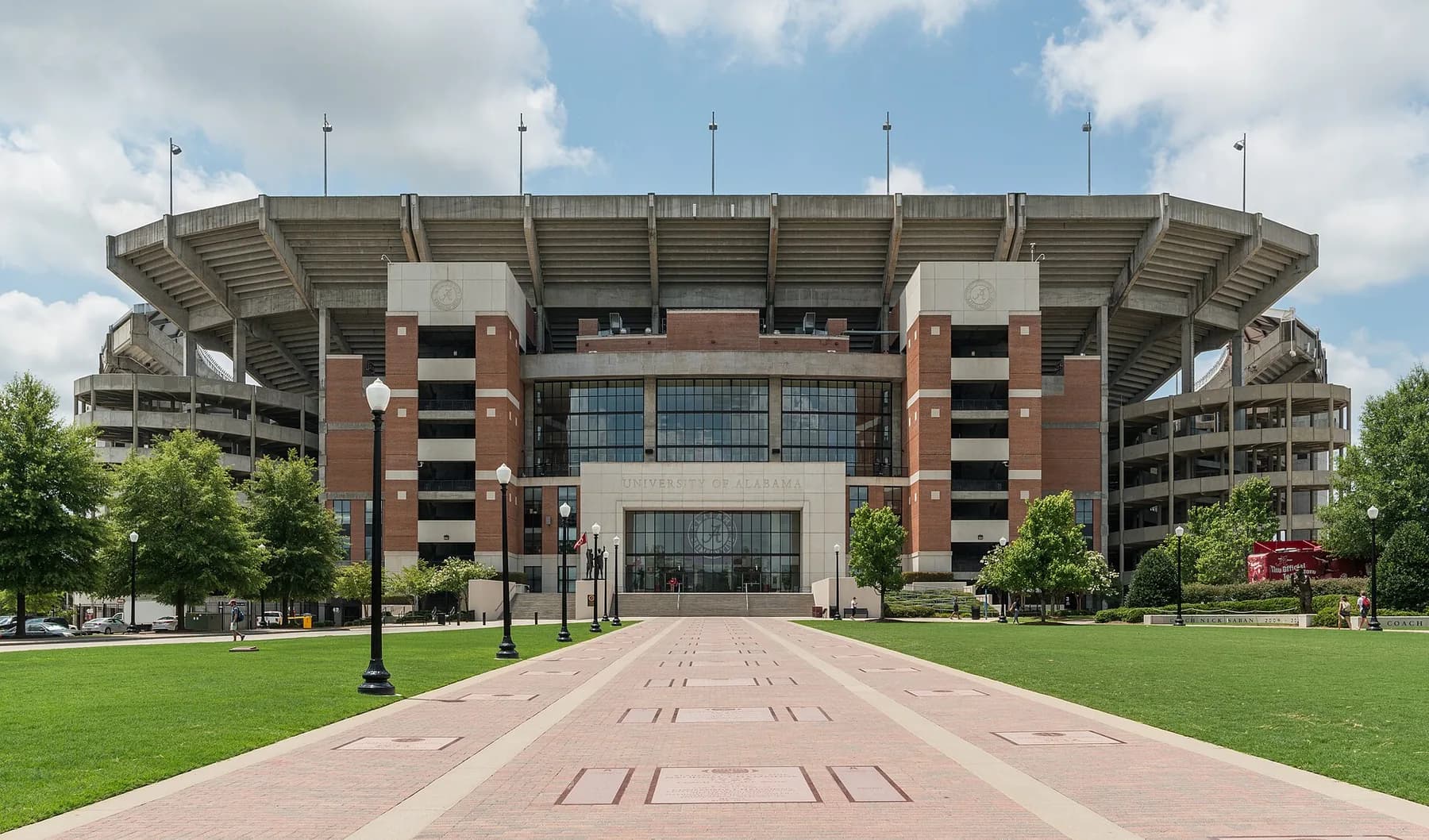
Photo: DXR · CC BY-SA 4.0 · Cropped for display
Up next · Week 10
Away
On the road at
Saturday, November 7 · Time TBA
The season, taking shape
Final scores show Alabama first. Oldest to newest.
at Mississippi StatePregame 34–24
Game details vs. Georgia
Pregame 28–25
Game details at Tennessee
Pregame 30–22
Original full-season forecast
This forecast retains the original probabilities for the full schedule. It does not update with completed results or this week’s forecast.
2026 results
Current record, team efficiency, player production, and verified results from completed games.
Current record
6-26 wins · 2 lossesThrough 8 completed gamesLoading player usage…
2026 season preview
Alabama enters Kalen DeBoer’s third season with a striking split between star power and collective trust. SEC media selected six Crimson Tide players to preseason all-conference teams but picked Alabama sixth overall. The roster has an established offensive focal point and a decorated secondary, yet quarterback and offensive-line questions sit at the center of everything. If Ryan Grubb can stabilize those two areas, Alabama has a playoff-caliber ceiling. If not, Kane Wommack and Maurice Linguist may spend the fall asking their most reliable unit to compensate for an uneven offense.
Original season forecast
The original SEC forecast, retained alongside current results.
SEC projected standing
#2
6-3 projected · 6.1 expected conference wins · #2 of 16.
Preseason baseline
2025 percentiles retained as preseason context; current results and player production lead this page.
2025 FBS percentile scale · 50 is average
Incoming class
National and conference recruiting ranks, confirmed commitments, and the highest-ranked recruits in this class.
Top committed recruits
Alabama2026 transfer movement
Incoming and outgoing transfer activity, with rated FBS-to-FBS moves below.
Incoming Transfers
AlabamaOutgoing Transfers
AlabamaSeason schedule
Completed games show final results. Upcoming games use this week’s forecast where available; later games retain their published season outlook.
Detailed football intelligence
The full team identity, offense, defense, and supporting evidence.
Team identity
Last season, Alabama tried to lean on the passing game; the approach gave the offense a dependable starting point.
Why it matters
The passing game was Alabama's more dependable way to stay ahead of the chains; opponents have to interrupt that rhythm without giving the run an easy box.
 vs. Texas A&M
Pregame 30–19
Game detailsPregame comparisons use preserved published forecasts. Results include wins and losses.
At a glance
Current form leads the outlook.
2026 rates aggregate verified completed-game box scores. EPA is expected points added per play.
| Player | C/ATT | YDS | TD | INT |
|---|---|---|---|---|
| Keelon Russell | 147/220 | 2050 | 15 | 5 |
| Austin Mack | 3/4 | 23 | 0 | 0 |
| Player | CAR | YDS | AVG | TD |
|---|---|---|---|---|
| Daniel Hill | 71 | 332 | 4.7 | 4 |
| Trae'shawn Brown | 64 | 324 | 5.1 | 5 |
| Keelon Russell | 66 | 251 | 3.8 | 5 |
| Player | REC | YDS | AVG | TD |
|---|---|---|---|---|
| Lotzeir Brooks | 29 | 488 | 16.8 | 1 |
| Rico Scott | 28 | 434 | 15.5 | 3 |
| Ryan Williams | 23 | 415 | 18.0 | 4 |
| Player | TOT | SOLO | TFL | SACK |
|---|---|---|---|---|
| Caleb Woodson | 61 | 27 | 4.5 | 2 |
| Luke Metz | 55 | 19 | 0.5 | 0 |
| Brayson Hubbard | 39 | 17 | 0.5 | 0 |
Saturday, October 24 · Bryant-Denny Stadium
Saturday, October 17 · Neyland Stadium
Saturday, October 10 · Bryant-Denny Stadium
DeBoer at least carries continuity among his principal scheme architects. Grubb remains the offensive coordinator, Wommack the defensive coordinator and Linguist the co-defensive coordinator and defensive backs coach. The systems do not need wholesale reinvention while the roster changes around them. Grubb’s task is to fit a new quarterback behind a line still seeking its best arrangement. Wommack and Linguist can begin with a secondary that already contains several of the team’s most accomplished players.
Keelon Russell and Austin Mack remained the leading quarterback candidates after A-Day. Russell delivered the stronger overall performance in that public scrimmage, while Mack produced several high-level downfield throws. Those snapshots kept both paths open rather than settling the competition, and Alabama had not publicly established a starter entering August. The winner must do more than make isolated throws: he will need to operate Grubb’s offense behind a developing front and be ready for a conference road game in Week 2.
Ryan Coleman-Williams gives either quarterback a clear place to start. The first-team preseason All-SEC receiver also represented Alabama at SEC media days, underscoring his standing as an offensive focal point and public leader. In the backfield, Trae’Shawn Brown emerged during spring as a credible early contributor with receiving value and the explosiveness to threaten the edge. Those traits could broaden Grubb’s playbook, but the larger question is whether the backfield can consistently produce the demanding carries required against SEC defenses.
Michael Carroll is the offensive line’s most established building block after earning second-team preseason All-SEC recognition, though his eventual value at guard or tackle remains an important piece of the alignment. Preseason projections placed transfer Terrance Green and sophomore London Simmons at the front of the tackle competition, while Jeremiah Beaman is returning from a 2025 season-ending injury. That is a plausible foundation, not a settled five. Green’s transition, Beaman’s recovery and the search for dependable rotation depth will shape both pass protection and the offense’s ability to stay balanced.
The secondary offers a much firmer starting point. Zabien Brown and Bray Hubbard were first-team preseason All-SEC selections, while Keon Sabb made the third team. Brown and Hubbard also joined Coleman-Williams as Alabama’s SEC media days representatives. Their presence gives Wommack and Linguist veteran leadership and coverage flexibility behind a front with more to prove. Yhonzae Pierre, a third-team preseason All-SEC linebacker, supplies a recognized edge threat, but one decorated pass rusher does not by itself settle the linebacker rotation or guarantee consistent pressure without extra rushers.
Roster turnover adds another layer to those questions. Alabama brought in 17 transfers and lost 24 during the 2026 cycle, creating a substantial integration job even with the coordinators returning. The issue is less the raw volume than how quickly new combinations become functional, particularly along the lines and in rotational roles. Alabama’s best players give the staff anchors; the season will test whether the supporting structure forms around them quickly enough.
The schedule provides little room for a slow offensive start. Alabama opens at home against East Carolina, visits Kentucky in Week 2 and hosts Florida State in Week 3. South Carolina then visits Tuscaloosa before Alabama travels to Mississippi State. October raises the pressure with Georgia at home, Tennessee on the road and Texas A&M at home on consecutive weekends. That three-game stretch should reveal whether the quarterback and line have moved from preseason questions to dependable answers.
November brings road games at LSU and Vanderbilt before Chattanooga visits Bryant-Denny Stadium, interrupting the conference schedule. Auburn then comes to Tuscaloosa for the regular-season finale. The late slate is demanding, but it is not a continuous eight-game SEC run. Alabama’s outlook ultimately rests on a straightforward proposition: Coleman-Williams and an accomplished secondary provide high-end talent, but Russell or Mack must take command, Carroll’s line must find a durable shape and Pierre’s front must complement the defensive backs. Until those pieces settle, Alabama is best viewed as a high-ceiling contender whose most consequential uncertainty sits on offense.
This preview is based on the linked public reporting and official program records.
Profile high point
Pressure held the profile's highest percentile position.Profile low point
The run game held the lowest percentile position among the profile's strength measures.

Front-seven disruption is what Alabama can trust most.
Why it matters
The defense has its best route to changing protection rules before coverage must hold; rushing structure remains the first counter an opponent should test.
The run game is Alabama's biggest concern, and opponents can test it immediately.
What matters
Alabama's rushing structure ranked in the lower national range last season.
For Alabama, the cleanest script is to use the passing game to stay on schedule and finish drives; fewer possessions make every empty drive more expensive.
What matters
Alabama's pass-first structure played at a deliberate pace. The pass game finished strong, while the run game finished weak.
Inside the team
Open a section for the football detail and supporting numbers.
The down-to-down question that determines whether the offense can keep both the run and pass available.
Opponents have to break Alabama's passing rhythm before it owns early downs.
Why it matters
If Alabama keeps finding routine completions, the defense cannot load the box or turn the rush loose.
The pace, play selection, and methods this offense uses to stay on schedule.
Alabama played at a deliberate pace in 2025.
What matters
Alabama worked with fewer possessions than most teams last season.
Alabama's prior passing record was strong.
Why it matters
A repeatable pass game can let Alabama punish loaded boxes without relying on low-frequency deep completions.
Alabama's prior rushing record was weak.
Why it matters
When Alabama's run game cannot stay on schedule, protection and passing-down execution carry more of the offense.
Alabama's explosive-play results were mixed rather than a defining edge.
Why it matters
A big play can still flip a possession, but last season's results do not make explosiveness something this team can rely on.
How consistently the offense creates manageable situations and the defense prevents them.
Alabama's defense was more consistent down to down than its offense.
Why it matters
Alabama's success rate shows whether it can sustain drives and get stops without relying on sacks, turnovers, or isolated big plays.
Opponent-adjusted EPA identifies the pass game as Alabama's stronger offensive unit.
Why it matters
If an opponent removes the first passing answer, the run game's lower adjusted value becomes the key counter to test.
Where the defense can create pressure, control the run, and end drives.
Alabama's prior defense was top-tier overall and strongest in disruption.
Why it matters
Opponents can start by testing the run fits early and trying to keep the offense balanced, though that unit still finished above-average. Alabama's disruption can still create negative plays and end drives, so the offense has to prove the opening will hold up.
Alabama's available disruption measures ranked among the best in the country last season; a charted pressure rate is not available.
Why it matters
Sustained disruption can create negative plays and give Alabama a better chance to end drives before third down.
Alabama's disruption regularly finished at the quarterback.
What matters
Both sack production and front-seven disruption cleared the FBS midpoint.
Alabama's prior run-defense results were above-average.
Why it matters
A dependable run front can let Alabama create obvious passing downs without committing extra bodies to the box.