
Analysis
Jelani Thurman and a rebuilt defense lead North Carolina past TCU in Dublin
Thurman gave Billy Edwards Jr. a game-changing target, while North Carolina kept TCU scoreless for the final 49 minutes of a 15–10 win.

North Carolina did not need a perfect offensive debut to leave Dublin with a meaningful win.
On a wet afternoon that turned into a downpour at times in the second half, Billy Edwards Jr. found Jelani Thurman for two explosive gains on the opening possession and the defense kept TCU scoreless for the final 49 minutes. The Tar Heels survived two turnovers and two late TCU drives inside the Carolina 10 to win 15–10.
The offense generated more big plays than the final score suggests. The defense made sure they were enough.
Thurman immediately changed the offense
Thurman’s final line—four catches for 94 yards—undersells the effect he had on the game.
Edwards hit him for 20 yards on Carolina’s first snap and 35 more two plays later. The second catch put the Tar Heels in position for their opening field goal and forced TCU to account for a matchup it never fully solved. Thurman added a 25-yard catch on Carolina’s final possession, moving the chains as the Tar Heels drained the clock.
He finished with more receiving yards Saturday than he recorded during the entire 2025 season at Ohio State, when he caught seven passes for 84 yards.
At 6-foot-6, Thurman is an obvious target in traffic. What stood out in Dublin was everything beyond his catch radius. He found open grass, gave Edwards clean throwing windows and produced after the catch. He looked less like a situational tight end and more like the player the passing game can run through.
Jordan Shipp added five catches for 71 yards, including gains of 19 and 18. TCU could not devote all of its attention to Thurman, and Carolina finally had two receivers capable of punishing that choice.
Edwards created explosives without giving the game away
Edwards completed 16 of 28 passes for 232 yards. He did not throw a touchdown, but he also did not throw an interception. His best sequence came late in the first quarter, when he converted fourth-and-7 with an 18-yard completion to Shipp before Jaylen McGill scored from nine yards out.
The encouraging number was eight. Using gains of at least 15 yards on passes and 10 yards on runs as the cutoff, Carolina produced eight explosive plays despite the rain—six through the air and two on the ground. The Tar Heels managed seven against TCU in last year’s opener, and their total offense climbed from 222 yards to 322. Even as the weather deteriorated, this offense created more ways to flip the field than the 2025 group did in dry conditions.
Thurman accounted for three of the six explosive completions. Shipp had two, and transfer receiver Trech Kekahuna added a 21-yard catch. Edwards also broke an 11-yard run, while Benjamin Hall supplied the other explosive rush with a 10-yard gain.
The weather and TCU’s pass rush made sustained offense difficult. Carolina finished 3-for-11 on third down, allowed three sacks and scored only three points after halftime. Edwards still pushed the ball downfield without putting it in danger. For an offense making its season debut, that was a useful starting point.
Benjamin Hall handled the workhorse share
Hall carried 11 times for 36 yards, both team highs, and functioned as the primary back in a committee. McGill added 33 yards on five carries and scored Carolina’s only touchdown.
The run game was not efficient enough. Carolina averaged 3.1 yards per carry, and Hall’s third-quarter fumble at the Tar Heels’ 24 nearly swung the game. But he took the first share of the early-down work, found 10 yards on Carolina’s first snap after halftime and remained part of the closing plan.
Calling Hall the workhorse describes his role, not a dominant rushing performance. Carolina trusted him with the largest share of the backfield; the line and the backs will need to turn that usage into more production.
Carolina’s defense owned the decisive downs
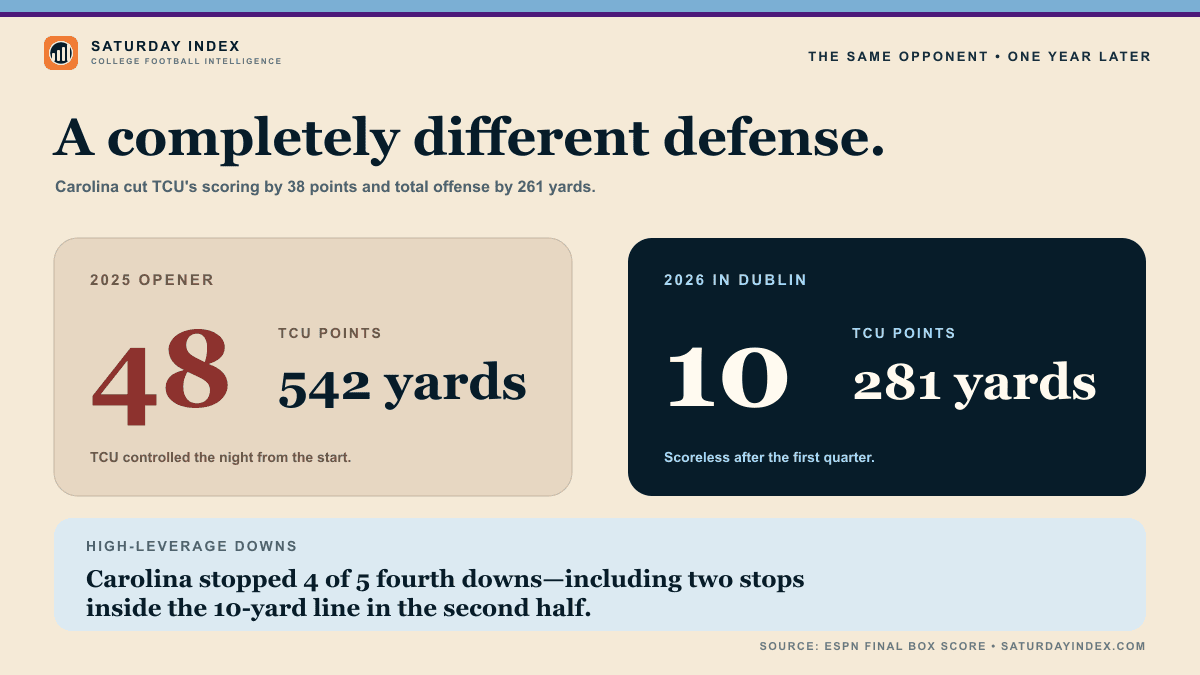
One year ago, TCU scored 48 points and gained 542 yards against North Carolina. In Dublin, the Horned Frogs finished with 10 points and 281 yards. Carolina cut TCU’s output by 38 points and 261 yards.
The performance was even more notable because defensive coordinator Steve Belichick was not with the team in Dublin. He has been away on medical leave since early August, leaving Carolina’s defensive staff to divide the coordinator responsibilities. The Tar Heels still played with a clear plan, rallied to the ball and tightened up when TCU crossed midfield.
The difference became clearest when the field shortened.
After Hall’s fumble, TCU moved to the Carolina 5 late in the third quarter. On fourth-and-1, the front stopped Jeremy Payne for a one-yard loss. In the fourth quarter, Craig moved the Horned Frogs to the 10 before his fourth-and-2 pass fell incomplete. TCU converted only one of five fourth-down attempts overall.
Xavier Lewis was disruptive throughout, finishing with two sacks and 4.5 tackles for loss. Melkart Abou Jaoude added a strip sack in the third quarter that led to Carolina’s final field goal. The Tar Heels produced three sacks and repeatedly won before TCU’s routes could develop.
The red-zone defense was not perfect—TCU scored a first-quarter touchdown—but it was unrecognizable from the group that surrendered 48 points in last year’s opener. When TCU received two short fields in the second half, Carolina allowed zero points.
Craig’s debut showed clear growing pains
Jaden Craig completed 20 of 32 passes for 175 yards without a touchdown or interception. In his first game directing TCU’s new offense, he rarely found an easy answer downfield and struggled when Carolina forced him beyond his first read.
He also lost the third-quarter fumble that Carolina converted into a field goal. TCU’s best offensive player was Payne, who ran 25 times for 142 yards, but the Horned Frogs could not consistently turn that rushing production into favorable throws. Eleven penalties for 90 yards made the problem worse.
Craig did move TCU into scoring position twice in the second half. He could not finish either possession. His timing and ball placement have to improve when the field compresses, but the larger issue was an offense that leaned too heavily on Payne and never found a reliable counter.
What the opener means
North Carolina leaves Ireland with more than a win. Thurman looked capable of changing the passing game, Edwards created chunk plays without an interception and the defense held TCU scoreless after the four-minute mark of the first quarter.
There are obvious corrections to make. The Tar Heels scored 15 points, lost two fumbles and never established the run. But the defense survived both turnovers, and the offense showed more explosive ability than it did in the same matchup a year ago—even after the rain intensified.
For TCU, Payne’s performance is the foundation. Craig’s development will determine whether the Horned Frogs can build a complete offense around him.
A year after TCU moved the ball almost at will, Carolina made the Horned Frogs earn every late yard and stopped them twice with the goal line behind the defense. That is the clearest sign yet that this version of North Carolina is different.