Analysis
Georgia–Alabama: the finishing job changes without Bowens
Georgia’s third-down offense meets Alabama’s third-down defense. The harder question is who turns the next first down into seven points.
Saturday, October 10 · 7:30 p.m. ET · ABC · Tuscaloosa
Georgia has reached the end zone on 24 of its 28 red-zone trips. Alabama has allowed opponents to convert only 19 of 69 third downs. Those five-game totals describe the confrontation better than two enormous scoring averages: the Bulldogs have been good at extending possessions and finishing them; the Tide have been good at getting the defense off the field. On Saturday, Georgia must try to preserve that chain without Chauncey Bowens.
The SEC’s initial report, posted Wednesday at 8:10 p.m. ET and still displayed Thursday morning, lists Bowens out. Saturday Index’s current projection is Alabama 27, Georgia 24, with Alabama at 58% to win and Georgia at 42%.
Georgia has to keep its choices open
Bowens has six rushing touchdowns and another receiving through five games. Georgia must replace that production while preserving the choices that make its offense difficult to defend. Nate Frazier has 211 rushing yards on 26 carries; the workload question remains relevant because Georgia’s Monday notes say he missed Oklahoma and played only a few second-half snaps against Vanderbilt.
The first useful observation will be Georgia’s backfield on an ordinary second-and-medium, before the goal line dictates personnel. Can Frazier, Dwight Phillips Jr. or Bo Walker threaten enough downhill yardage to hold Alabama’s linebackers? If so, Gunner Stockton can keep the handoff, quick throw and keeper in the same conversation. If Alabama can squeeze those runs without extra help, the passing windows become narrower.
Stockton gives Georgia a way to make an unblocked defender wrong: when that defender closes on the back, a quarterback keep can attack the space he vacates. But repeated quarterback carries have a cost, especially if they merely recover yards lost on first down. The valuable version is a selective constraint that helps the backs, not an assumption that Stockton will absorb Bowens’s workload.
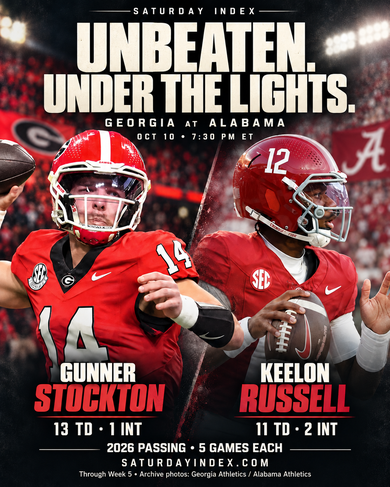
Stockton has completed 77 of 102 passes for 1,049 yards, 13 touchdowns and one interception. Alabama’s secondary has eight interceptions, but it has also allowed 7.65 yards per pass attempt. That creates a real choice for Georgia: protect the ball without becoming so conservative that the Tide can sit on the first available route. Talyn Taylor and the tight ends become particularly interesting when Alabama crowds the shorter throws.
Russell needs the room behind the rush defense
Keelon Russell’s official line is 94 completions in 132 attempts, 1,414 yards, 11 touchdowns and two interceptions. Ryan Coleman-Williams and Lotzeir Brooks have combined for 728 receiving yards. Georgia cannot treat the running game and those receivers as separate problems: each additional defender committed to the box leaves less help against a route breaking beyond him.
Georgia has allowed 57.4 rushing yards per game and 1.9 per attempt, including sacks, through five games. If Elijah Griffin and Jordan Hall help maintain that resistance without drawing KJ Bolden forward, the Bulldogs can preserve deeper coverage. Watch the safety’s first steps on play action and the room available to Coleman-Williams or Brooks after the catch. A sound first tackle would let Georgia keep its coverage priorities intact on the next snap.
Alabama has also surrendered 12 sacks. A productive rushing start would make Georgia respect more than the obvious passing downs; an early deficit would make Russell’s protection more predictable. The Tide do not need every handoff to break free. They need enough useful gains that Georgia’s front cannot attack the same launch point on consecutive snaps.
The two possessions to watch
Georgia’s 28 conversions in 51 third downs meet Alabama’s 19 allowed in 69. Those are descriptive results against different schedules, not a forecast of Saturday’s conversion rate. The most revealing pair of possessions will be Georgia’s first third-and-short after a successful run, then Alabama’s first drive forced to begin again after a sack. Each tests whether the offense retains multiple answers when its preferred path closes.
Weather could change that test. The National Weather Service’s Thursday-morning Tuscaloosa forecast calls for a windy, wet Saturday, followed by a 50% chance of showers Saturday night. The daytime forecast includes gusts up to 45 mph; Saturday-night conditions may differ. If conditions remain disruptive, exchanges, shorter throws and the decision to attempt a longer kick become more consequential.
Explore the free Georgia–Alabama report and quarterback charts