
Pass Protection

Miami has the edgeClear advantage
Miami has the stronger passing matchup. Stanford needs pressure and disciplined coverage to keep completions from becoming explosive plays.
Saturday Index
Loading matchup intelligenceBringing the latest verified football information into focus.

Home field · Stanford Stadium
Photo: NASA World Wind · Public domain · Cropped for display
Hurricanes
2025 record: 10-2 · ACC
Saturday Index win outlook
94%
Miami leads the Saturday Index outlook
Miami win probability 94%; Stanford win probability 6%.
Cardinal
2025 record: 4-8 · ACC

Miami's protection should give the passing game room to work.
Miami’s Week 1 trip to Stanford puts quarterback transitions under pressure. The Hurricanes installed Duke transfer Darian Mensah after he threw for 3,973 yards and 34 touchdowns in 2025, giving Shannon Dawson a veteran distributor whose central task is building timing within a reshaped offense. Stanford ended spring without naming a starter among Davis Warren, Dylan Rizk, Charlie Mirer and Mike Mitchell Jr. Warren has the experience edge after nine Michigan starts, but little Stanford continuity surrounds the competition. Miami is testing whether a rebuilt roster can click quickly; Stanford is trying to establish an identity around a new quarterback and skill group.
The decisive matchup is Miami’s rebuilt offensive line against the center of Stanford’s defense. Four Hurricanes starters departed, leaving Matt McCoy, Samson Okunlola and Ryan Rodriguez as the returning core while positions and depth remain unsettled. They must create room for Mark Fletcher Jr., who ran for 1,192 yards last season, against a Cardinal defense organized around linebacker Matt Rose. Rose made 106 tackles and eight tackles for loss in 2025, and Stanford’s emphasis on gap discipline fits the assignment: prevent Fletcher from keeping Mensah ahead of schedule. If the Cardinal creates obvious passing downs, Miami’s new protection combinations—not Mensah’s distribution to Malachi Toney—will carry the game.
A quick visual read on team strengths, expected pace, and the matchups that can shape the game.
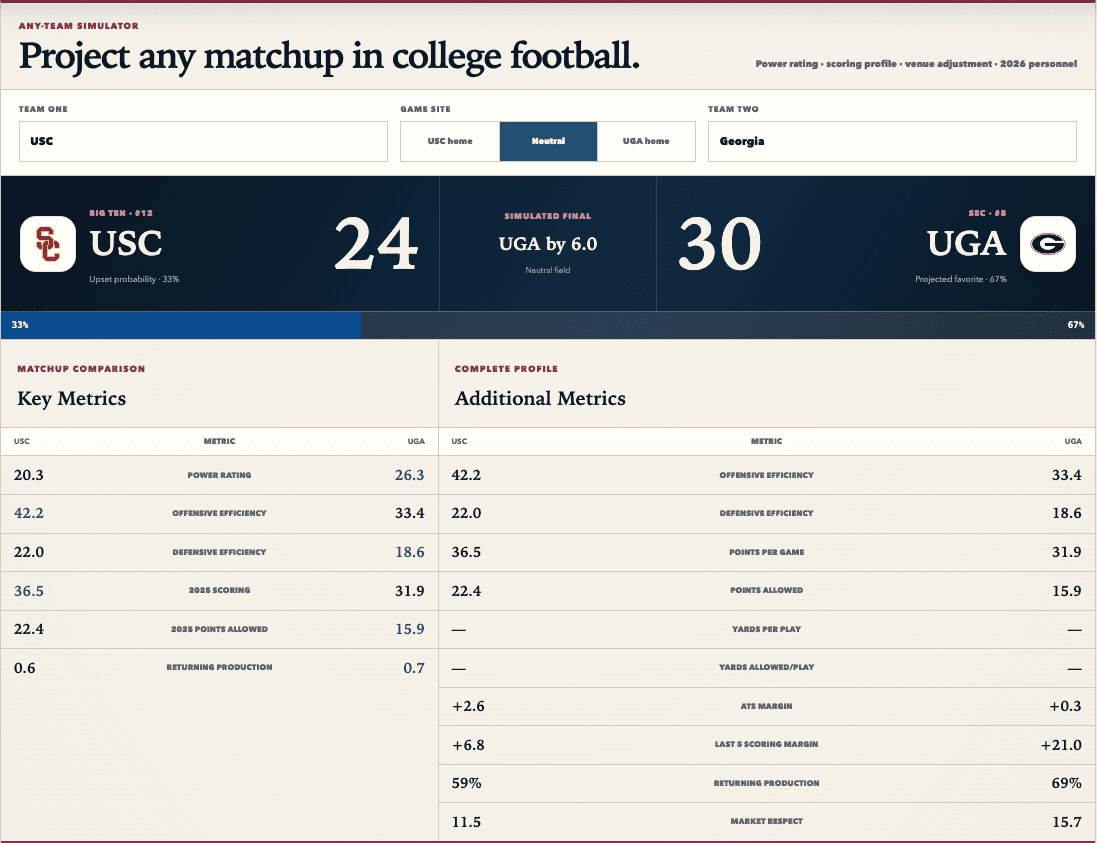
Premium opens the full metric detail.
MIAAwaySTANHomeMIAMIASee the projected final, exact advanced metrics, returning-production detail, personnel continuity, and deeper market context for every verified matchup.
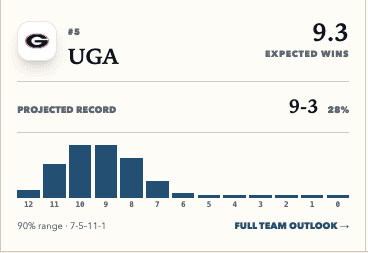
100,000 simulated seasons.Every record path, win total, and conference race in one view.
Miami can control the night by starting with Fletcher, using Toney as Mensah’s answer and avoiding situations that expose the line. Defensively, Damon Wilson II and the rebuilt front need to create pressure without Rueben Bain Jr. and Akheem Mesidor. Stanford’s path is to lean into its promised physical run game, put Micah Ford behind an older line anchored by left tackle Niki Prongos, and keep its quarterback out of long yardage. Rose must close interior lanes while Brandon Nicholson and Jay Green limit explosive throws. Stanford can shorten the game and test Miami’s patience; Miami can seize it by making the Cardinal’s unresolved quarterback situation carry the burden.
MIAMIAMIAExpected paceTypical possessions
The matchups most likely to shape Saturday.
Miami has the stronger passing matchup. Stanford needs pressure and disciplined coverage to keep completions from becoming explosive plays.
Miami holds the clearer matchup advantage. Stanford needs to control this area to keep the game balanced.
Miami has the stronger passing matchup. Stanford needs pressure and disciplined coverage to keep completions from becoming explosive plays.
Miami holds the clearer matchup advantage. Stanford needs to control this area to keep the game balanced.